Introduction
The United States has one of the most powerful economies in the world, and almost every major financial market reacts to U.S. decisions. Whether it is a trade agreement, debt ceiling deal, tariff policy, interest rate decision, sanctions package, or crypto regulation, investors around the world closely watch what America does.
This is why U.S. deals can strongly affect both the stock market and the crypto market. A single announcement from the U.S. government, Federal Reserve, Treasury Department, or Securities and Exchange Commission can move billions of dollars within minutes.
For traders and investors, understanding the impact of U.S. deals is very important. Stocks, Bitcoin, Ethereum, altcoins, gold, oil, and the U.S. dollar often react quickly when America signs a major deal or changes its economic policy.
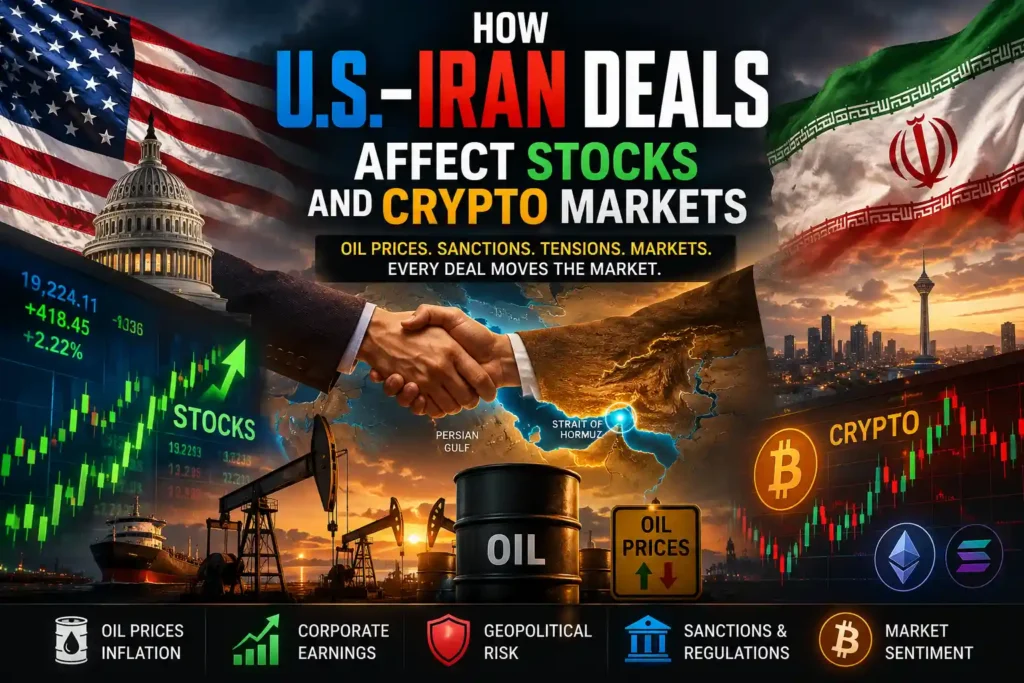
In this article, we will explain how U.S. deals affect stocks and crypto, why markets react so strongly, and what investors should watch before making trading decisions.
Why U.S. Deals Matter So Much for Global Markets
The U.S. economy plays a central role in global finance. The U.S. dollar is the world’s most important reserve currency, Wall Street is home to the largest stock exchanges, and many global investors use American markets as a signal for risk appetite.
When the United States announces a major economic or political deal, investors immediately ask:
Will this help businesses grow?
Will inflation increase or decrease?
Will interest rates go up or down?
Will the U.S. dollar become stronger or weaker?
Will investors take more risk or move to safer assets?
The answers to these questions directly affect stocks and cryptocurrencies.
Stocks usually react based on company profits, economic growth, interest rates, and investor confidence. Crypto reacts based on liquidity, regulation, risk sentiment, dollar strength, and institutional adoption.
That is why U.S. deals can create strong market movements.
Types of U.S. Deals That Affect Stocks and Crypto
Not all U.S. deals affect the market in the same way. Some deals are positive for stocks but negative for crypto. Some support Bitcoin but hurt traditional companies. Others create uncertainty and cause both markets to fall.
Here are the most important types of U.S. deals investors should understand.
1. Trade Deals and Tariff Agreements
Trade deals are agreements between countries about imports, exports, taxes, tariffs, and business rules. When the U.S. signs a trade deal with another country, it can affect companies that depend on global supply chains.
For example, if the U.S. reduces tariffs on imported goods, companies may pay less for raw materials and products. This can improve profit margins and support stock prices.
On the other hand, if the U.S. increases tariffs, companies may face higher costs. This can reduce profits, increase inflation, and put pressure on the stock market.
How Trade Deals Affect Stocks
Trade deals can directly affect sectors such as:
Technology
Automobiles
Manufacturing
Retail
Energy
Agriculture
Shipping and logistics
If a trade deal improves business conditions, investors may buy stocks in companies that benefit from lower costs and better international access.
For example, technology companies may benefit if chip supply chains become smoother. Retail companies may benefit if imported goods become cheaper. Agriculture companies may benefit if foreign countries agree to buy more U.S. products.
However, if trade tensions increase, stocks may fall because investors fear higher costs, weaker demand, and slower economic growth.
How Trade Deals Affect Crypto
Crypto does not depend on trade deals in the same direct way as stocks, but it is still affected indirectly.
When trade deals reduce uncertainty, investors often become more confident and may take more risk. This can support Bitcoin, Ethereum, and altcoins.
But when trade conflicts increase, investors may become nervous. In some cases, Bitcoin may rise as an alternative asset. In other cases, crypto may fall because investors sell risky assets and move into cash or the U.S. dollar.
The reaction depends on market conditions. If traders see Bitcoin as a risk asset, it may fall with stocks. If they see it as a hedge against government policy or currency weakness, it may rise.
2. Federal Reserve Interest Rate Decisions
One of the biggest forces behind both stocks and crypto is U.S. interest rate policy.
The Federal Reserve controls monetary policy in the United States. When inflation is high, the Fed may keep interest rates higher. When the economy slows, the Fed may cut rates to support growth.
Why Interest Rates Matter
Higher interest rates usually make borrowing more expensive. This can reduce business investment, slow consumer spending, and pressure stock valuations.
Growth stocks, especially technology stocks, are often sensitive to interest rates because investors value them based on future earnings. When rates rise, future earnings become less attractive in today’s value.
Crypto is also sensitive to interest rates because it depends heavily on market liquidity. When money is cheap and liquidity is high, investors are more willing to buy risky assets like Bitcoin and altcoins. When rates are high, money becomes tighter, and investors often reduce risk.
Rate Cuts vs Rate Hikes
If investors expect U.S. interest rates to fall, stocks and crypto may rise because lower rates can support liquidity and risk-taking.
If investors expect U.S. interest rates to rise, stocks and crypto may fall because higher rates make cash, bonds, and the U.S. dollar more attractive.
This is why markets move sharply after Federal Reserve meetings, inflation reports, job data, and speeches from Fed officials.
3. U.S. Debt Ceiling and Government Spending Deals
Another major market-moving event is a U.S. debt ceiling or government funding deal.
The debt ceiling is the limit on how much the U.S. government can borrow. When political leaders negotiate over debt and spending, markets become nervous because failure to reach a deal can create uncertainty.
Impact on Stocks
If the U.S. government reaches a debt deal, stocks may rise because investors feel relief. A deal reduces the risk of government shutdowns, delayed payments, or financial instability.
However, the details matter. If the deal includes spending cuts, some sectors may be affected negatively. If it includes more government spending, sectors like defense, infrastructure, healthcare, and energy may benefit.
Impact on Crypto
Crypto may react strongly to debt ceiling news because Bitcoin investors often focus on government debt, money supply, and confidence in fiat currencies.
If investors believe U.S. debt is rising too fast, some may buy Bitcoin as a long-term hedge against currency weakness. But during short-term panic, crypto can also fall because traders sell risky assets to raise cash.
This is why debt-related news can create mixed reactions in crypto markets.
4. U.S. Crypto Regulation Deals
Crypto regulation is one of the most important factors for Bitcoin, Ethereum, and altcoins.
When the U.S. government creates clear rules for crypto exchanges, stablecoins, ETFs, custody, and digital assets, it can increase investor confidence. Institutional investors prefer regulated markets because they need legal clarity before investing large amounts of money.
Positive Regulation Can Support Crypto
If the U.S. approves crypto products, creates stablecoin rules, or allows more institutional access, crypto markets may react positively.
Clear regulation can help:
Increase institutional investment
Reduce fear of sudden bans
Improve exchange transparency
Support Bitcoin ETFs and crypto funds
Attract long-term investors
Bitcoin usually benefits the most from positive regulatory clarity because it is the most established cryptocurrency.
Negative Regulation Can Hurt Crypto
If the U.S. increases enforcement, restricts exchanges, targets stablecoins, or creates strict compliance rules, crypto prices may fall.
Altcoins are usually more sensitive than Bitcoin because many smaller tokens face greater regulatory uncertainty.
If investors fear that a token may be classified as a security or removed from exchanges, they may sell quickly.
5. Sanctions and Geopolitical Deals
The U.S. also uses sanctions as a financial tool. Sanctions can target countries, companies, banks, crypto exchanges, and individuals.
When the U.S. announces sanctions, it can affect global markets because it changes how money moves across borders.
Impact on Stocks
Sanctions can affect energy prices, defense stocks, banks, shipping companies, and international businesses.
For example, sanctions on oil-producing countries may push oil prices higher. This can support energy stocks but hurt airlines, transport companies, and consumers.
Sanctions can also increase geopolitical risk. When uncertainty rises, investors may move away from risky stocks and buy safer assets such as the U.S. dollar, gold, or Treasury bonds.
Impact on Crypto
Crypto can react strongly to sanctions news because digital assets are sometimes used in cross-border transactions.
If the U.S. targets crypto exchanges or wallets linked to sanctions evasion, the market may become nervous. This can hurt exchanges, privacy coins, and smaller tokens.
However, some investors may also view Bitcoin as a decentralized alternative during geopolitical uncertainty. This can sometimes support Bitcoin demand, especially when trust in traditional financial systems weakens.
6. U.S. Dollar Strength and Market Liquidity
Most global assets are priced against the U.S. dollar. This makes the dollar extremely important for both stocks and crypto.
When U.S. deals strengthen the dollar, crypto often faces pressure. A stronger dollar usually means global liquidity is tighter, and investors may prefer cash or dollar-based assets.
When the dollar weakens, Bitcoin and risk assets may benefit because investors look for alternatives.
Dollar Up, Crypto Down?
In many market conditions, Bitcoin moves opposite to the U.S. dollar. When the dollar rises strongly, Bitcoin may struggle. When the dollar weakens, Bitcoin may gain momentum.
This is not always true, but it is a common pattern traders watch.
Stocks can also be affected by dollar strength. A stronger dollar can hurt large U.S. companies that earn revenue overseas because foreign profits become less valuable when converted back into dollars.
7. Corporate Deals, Mergers, and Government Contracts
U.S. deals are not only about politics. Large corporate deals also affect stocks and sometimes crypto.
Mergers, acquisitions, defense contracts, infrastructure deals, and AI investment announcements can move specific sectors.
For example:
A major AI deal can lift technology stocks.
A defense contract can support defense companies.
An energy deal can move oil and gas stocks.
A banking merger can affect financial stocks.
A crypto partnership can boost blockchain-related companies.
Crypto-related stocks such as Bitcoin miners, crypto exchanges, payment companies, and blockchain firms may react strongly to U.S. corporate deals involving digital assets.
How Different Stock Sectors React to U.S. Deals
Different sectors react differently to U.S. news.
Technology Stocks
Tech stocks usually benefit from lower interest rates, AI investment, chip deals, and strong consumer demand. However, they may fall if trade restrictions affect semiconductors or global supply chains.
Banking Stocks
Banks often benefit from higher interest rates because they can earn more from lending. But if rates become too high and hurt the economy, bank stocks may fall due to credit risk.
Energy Stocks
Energy stocks react strongly to sanctions, oil deals, Middle East tensions, and U.S. production policy. Higher oil prices can support energy companies but hurt consumers.
Defense Stocks
Defense stocks may rise during geopolitical tensions or when the U.S. signs major military spending deals.
Retail Stocks
Retail companies are sensitive to tariffs, consumer spending, inflation, and supply chain costs. Lower import costs can help retailers, while higher tariffs can hurt profits.
How Bitcoin and Altcoins React Differently
Bitcoin, Ethereum, and altcoins do not always move the same way.
Bitcoin
Bitcoin is often seen as the strongest and safest crypto asset. It usually reacts to interest rates, ETF flows, dollar strength, inflation expectations, and institutional demand.
When U.S. policy increases confidence in crypto, Bitcoin may lead the market higher.
Ethereum
Ethereum reacts to crypto regulation, DeFi activity, institutional adoption, and network upgrades. It can benefit from positive crypto sentiment but may face pressure if regulators focus on staking or DeFi platforms.
Altcoins
Altcoins are usually the most volatile. They can rise quickly during risk-on markets but fall sharply during uncertainty.
When U.S. deals increase liquidity and investor confidence, altcoins may outperform. When regulation or interest rate fears rise, altcoins often suffer more than Bitcoin.
Why Markets Sometimes React Opposite to Expectations
Sometimes good news causes the market to fall, and bad news causes the market to rise. This happens because markets do not only react to the news itself. They react to expectations.
For example, if investors already expected a positive trade deal, stocks may not rise much after the announcement. The good news was already priced in.
If a Federal Reserve decision sounds less friendly than expected, markets may fall even if rates remain unchanged.
This is why traders often say:
“Markets move on expectations, not just headlines.”
Before reacting to U.S. news, investors should ask:
Was this news already expected?
Is the deal better or worse than expected?
How will it affect inflation?
How will it affect interest rates?
How will it affect liquidity?
Which sectors benefit or lose?
Key Indicators Traders Should Watch
To understand how U.S. deals may affect stocks and crypto, traders should watch the following indicators:
U.S. Dollar Index
Federal Reserve interest rate expectations
Treasury bond yields
Inflation data
Jobs reports
Stock market futures
Bitcoin dominance
ETF inflows and outflows
Oil prices
Gold prices
VIX volatility index
Government policy announcements
SEC and Treasury updates
These indicators help traders understand whether the market is moving into risk-on or risk-off mode.
Risk-On vs Risk-Off Market Reaction
U.S. deals often push markets into either a risk-on or risk-off environment.
Risk-On
Risk-on means investors are confident and willing to buy risky assets. In this environment, stocks, Bitcoin, Ethereum, and altcoins may rise.
Risk-on conditions usually happen when:
Interest rates are expected to fall
Inflation is cooling
Trade tensions are reduced
Regulation becomes clearer
Economic growth remains strong
Liquidity improves
Risk-Off
Risk-off means investors are nervous and prefer safer assets. In this environment, stocks and crypto may fall.
Risk-off conditions usually happen when:
Interest rates are expected to rise
Inflation remains high
Trade tensions increase
Geopolitical risk grows
Regulation becomes stricter
The dollar strengthens sharply
Understanding risk sentiment is one of the most important skills for traders.
Example: How One U.S. Deal Can Move Both Markets
Imagine the U.S. signs a major trade deal that reduces tariffs and improves business relations with a major economy.
Stocks may rise because companies expect lower costs and higher profits.
Technology and manufacturing stocks may benefit because supply chains become smoother.
The U.S. dollar may weaken if investors move into riskier assets.
Bitcoin may rise because risk appetite improves.
Altcoins may rise even more because traders become more aggressive.
But if the same deal increases inflation or creates political uncertainty, the reaction may be different. Stocks may become volatile, bond yields may rise, and crypto may fall.
This shows why traders must look beyond the headline and understand the full economic impact.
Final Thoughts
U.S. deals have a powerful impact on both stocks and crypto because America sits at the center of the global financial system.
Trade deals, tariff agreements, debt deals, Federal Reserve policy, sanctions, crypto regulation, and corporate agreements can all move markets.
For stock investors, the key question is how the deal affects company profits, economic growth, and interest rates.
For crypto investors, the key question is how the deal affects liquidity, regulation, dollar strength, and risk appetite.
The most important lesson is this: do not trade only based on headlines. Always study the details, market expectations, and broader economic conditions.
U.S. deals can create major opportunities, but they can also create sudden volatility. Smart investors watch the news, understand the reaction, manage risk, and avoid emotional decisions.
FAQs
Do U.S. deals affect Bitcoin?
Yes, U.S. deals can affect Bitcoin because they influence investor confidence, the U.S. dollar, liquidity, regulation, and risk appetite.
Why does the stock market react to U.S. trade deals?
Stocks react because trade deals can change company costs, supply chains, tariffs, exports, and profit expectations.
Can U.S. interest rate decisions affect crypto?
Yes. Higher interest rates usually reduce liquidity and can pressure crypto prices. Lower interest rates can support risk assets, including Bitcoin and altcoins.
Are U.S. sanctions good or bad for crypto?
It depends. Sanctions can create fear in crypto markets if exchanges or wallets are targeted. But geopolitical uncertainty can also increase interest in Bitcoin as an alternative asset.
Which crypto is most affected by U.S. policy?
Bitcoin is strongly affected by U.S. interest rates, ETF demand, and dollar strength. Altcoins are usually more affected by regulation and risk sentiment.
Should investors buy stocks or crypto after a U.S. deal?
Investors should not buy only because of a headline. They should analyze the details, market expectations, liquidity conditions, and risk before making any decision.
Disclaimer: This article is for educational purposes only and should not be considered financial advice. Always do your own research before investing or trading.