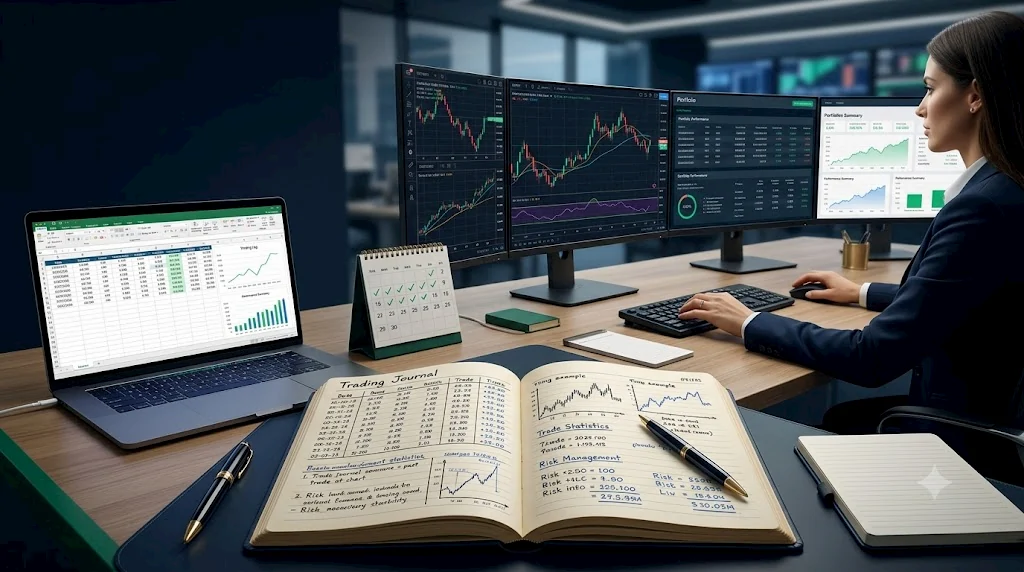
Successful trading is about more than finding profitable opportunities. Long-term consistency often depends on discipline, continuous learning, and the ability to evaluate past decisions objectively. One of the most effective tools for achieving this is a trading journal.
Whether you trade Forex, stocks, cryptocurrencies, commodities, or CFDs, maintaining a trading journal can help you identify strengths, correct recurring mistakes, and refine your strategy over time. Professional traders often view journaling as an essential part of their routine rather than an optional task.
In this guide, we’ll explore why trading journals matter, what information to record, and how they can contribute to long-term success.
What Is a Trading Journal?
A trading journal is a detailed record of your trading activity. Unlike a broker’s account history, a journal also captures the reasoning behind each trade, your emotional state, and lessons learned.
A complete trading journal may include:
- Trade date and time
- Market traded
- Entry and exit prices
- Position size
- Trade direction (buy or sell)
- Stop-loss and take-profit levels
- Risk-to-reward ratio
- Profit or loss
- Screenshots of the chart
- Reason for entering the trade
- Market conditions
- Emotional state before and after the trade
- Key observations and lessons
The goal is not just to record results, but to understand why those results occurred.
Why Every Trader Needs a Trading Journal
1. Identify Patterns in Your Performance
Over time, a journal helps reveal patterns that may not be obvious from individual trades.
You might discover that:
- Certain setups perform better than others.
- You trade more effectively during specific market sessions.
- Particular assets consistently match your trading style.
- Certain conditions lead to lower-quality decisions.
Recognizing these patterns allows you to focus on what works and reduce exposure to strategies that underperform.
2. Improve Trading Discipline
Successful traders follow a plan rather than reacting impulsively.
Recording every trade encourages accountability because you know each decision will be reviewed later. This can reduce emotional trading and reinforce adherence to your trading rules.
3. Strengthen Risk Management
A journal provides valuable insights into how you manage risk.
Track metrics such as:
- Average risk per trade
- Win rate
- Average winning trade
- Average losing trade
- Risk-to-reward ratio
- Maximum drawdown
Monitoring these statistics can help you identify whether your risk management aligns with your overall strategy.
4. Learn from Mistakes
Every trader experiences losing trades.
Instead of viewing losses as failures, use them as learning opportunities by asking questions like:
- Did I follow my trading plan?
- Was the setup valid?
- Did I enter too early or too late?
- Did emotions influence my decision?
- Was my position size appropriate?
Documenting these answers makes it easier to avoid repeating the same mistakes.
5. Control Emotions
Trading psychology often separates consistent traders from inconsistent ones.
A journal can help you recognize emotional triggers such as:
- Fear after consecutive losses
- Overconfidence after a winning streak
- Revenge trading
- FOMO (Fear of Missing Out)
- Impatience
By identifying these patterns, you can develop healthier decision-making habits.
What Should a Good Trading Journal Include?
A practical journal typically records:
Trade Details
- Instrument traded
- Date and time
- Buy or sell
- Entry and exit prices
- Position size
- Stop-loss
- Take-profit
Strategy
- Trading setup
- Technical indicators used
- Market trend
- Key support and resistance levels
Psychology
- Confidence level
- Emotional state
- Stress level
- Whether the trade followed your plan
Results
- Profit or loss
- Risk-to-reward ratio
- Notes on what worked
- Areas for improvement
Adding screenshots before and after the trade can provide additional context during future reviews.
Digital vs. Paper Trading Journals
Digital Journals
Advantages:
- Easy to organize and search
- Performance analytics
- Cloud storage
- Chart screenshots
- Automatic calculations
Paper Journals
Advantages:
- Encourages thoughtful reflection
- No software required
- Flexible format
- Fewer distractions
The best choice depends on your personal workflow and preferences. Some traders even combine both methods.
Reviewing Your Journal
Keeping a journal is only part of the process. Regular reviews are where the greatest value often comes from.
Consider reviewing your journal:
- Weekly
- Monthly
- Quarterly
During each review, evaluate:
- Best-performing strategies
- Most common mistakes
- Average trade duration
- Win rate
- Overall profitability
- Emotional consistency
This ongoing feedback loop can help refine your trading approach.
Common Mistakes to Avoid
Recording Only Winning Trades
Include every trade, regardless of the outcome. Losses often provide the most valuable lessons.
Being Too Vague
Detailed notes are more useful than general comments like “bad trade.”
Skipping Reviews
A journal is most effective when it is reviewed consistently.
Ignoring Emotions
Psychological observations are just as important as technical details.
Tips for Building a Consistent Journaling Habit
- Record trades immediately after they close.
- Use the same format for every entry.
- Include screenshots whenever possible.
- Review your journal on a regular schedule.
- Focus on process quality rather than short-term profits.
- Update your trading plan based on recurring insights.
Frequently Asked Questions (FAQs)
Do professional traders keep journals?
Many professional traders use journals to analyze performance, monitor discipline, and refine strategies over time.
Can a trading journal improve profitability?
A journal cannot guarantee profits, but it can help traders identify mistakes, improve consistency, and strengthen decision-making.
Should beginners keep a trading journal?
Yes. Journaling from the beginning helps build good habits and accelerates the learning process.
Is a spreadsheet enough?
For many traders, a spreadsheet is sufficient. Others prefer dedicated journaling software that offers analytics and performance tracking.
Final Thoughts
A trading journal is one of the most valuable tools available to traders at any experience level. It encourages discipline, supports better risk management, and creates a structured way to learn from both successes and setbacks.
While keeping a journal requires consistency, the insights gained over time can help you refine your strategy, manage emotions more effectively, and make better-informed trading decisions. In the long run, improving your trading process is often more important than focusing on the outcome of any single trade.
Disclaimer: This article is for educational and informational purposes only and should not be considered financial or investment advice. Trading in Forex, CFDs, stocks, commodities, and cryptocurrencies involves significant risk, and past performance does not guarantee future results. Always conduct your own research and use appropriate risk management before making trading decisions.