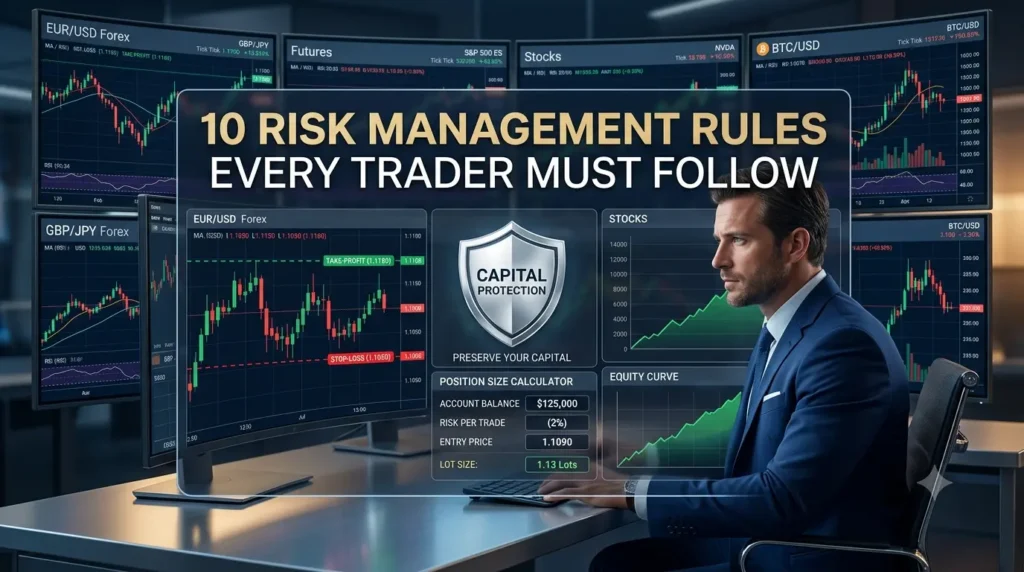
Many traders spend countless hours searching for the perfect trading strategy, indicator, or market setup. However, one factor separates long-term winners from those who consistently lose money: risk management.
Even the best trading strategy cannot save an account if risk is poorly managed. Professional traders understand that preserving capital is the foundation of long-term success.
Whether you trade Forex, Futures, Stocks, or Cryptocurrency, these 10 risk management rules can help you become a more disciplined and profitable trader.
Risk Management Rules!
1. Never Risk More Than 1–2% Per Trade
One of the oldest rules in trading is also one of the most effective.
Limiting your risk to 1–2% of your trading account on each trade helps protect you from devastating losses and allows you to survive losing streaks.
2. Always Use a Stop-Loss
A stop-loss is your safety net.
Markets can move unexpectedly due to economic data, geopolitical events, or sudden volatility. A predefined stop-loss prevents one trade from causing significant damage to your account.
3. Maintain a Positive Risk-to-Reward Ratio
Before entering a trade, ask yourself:
“Is the potential reward worth the risk?”
Many successful traders look for setups that offer at least a 1:2 risk-to-reward ratio, meaning the potential profit is twice the amount being risked.
4. Don’t Overleverage
Leverage can amplify profits—but it can also magnify losses.
Using excessive leverage is one of the fastest ways to blow a trading account. Trade with leverage responsibly and understand its impact on your position size.
5. Avoid Overtrading
Not every market move is a trading opportunity.
Professional traders wait patiently for high-quality setups instead of forcing trades out of boredom or fear of missing out (FOMO).
6. Diversify Your Exposure
Avoid placing all your risk on highly correlated assets.
For example, opening multiple positions that all depend on the same market direction can increase your overall risk more than you realize.
7. Keep Emotions Out of Trading
Fear and greed are responsible for many costly mistakes.
Follow your trading plan, trust your analysis, and avoid making impulsive decisions after a win or a loss.
8. Keep a Trading Journal
Record every trade, including:
- Entry and exit points
- Risk taken
- Trade rationale
- Outcome
- Lessons learned
Reviewing your journal regularly helps identify strengths and weaknesses in your trading approach.
9. Know When to Stop
Set a daily or weekly loss limit.
If you reach it, step away from the market and reassess your strategy. Continuing to trade while frustrated often leads to revenge trading and larger losses.
10. Think Like a Professional
Professional traders focus on consistency, not excitement.
They understand that protecting capital is more important than chasing quick profits. A disciplined approach can produce steady growth over time.
Common Risk Management Mistakes
Many traders fail because they:
- Increase position sizes after losses.
- Remove stop-loss orders.
- Risk too much on a single trade.
- Ignore their trading plan.
- Let emotions drive decisions.
Avoiding these mistakes can significantly improve your long-term performance.
Final Thoughts
Risk management isn’t the most exciting part of trading, but it is arguably the most important.
A profitable strategy combined with poor risk management can still lead to failure. On the other hand, disciplined risk management can help even average strategies perform consistently over time.
Remember, successful traders don’t aim to win every trade—they aim to protect their capital so they can continue trading tomorrow.
If you want a long and successful trading career, make risk management your highest priority.