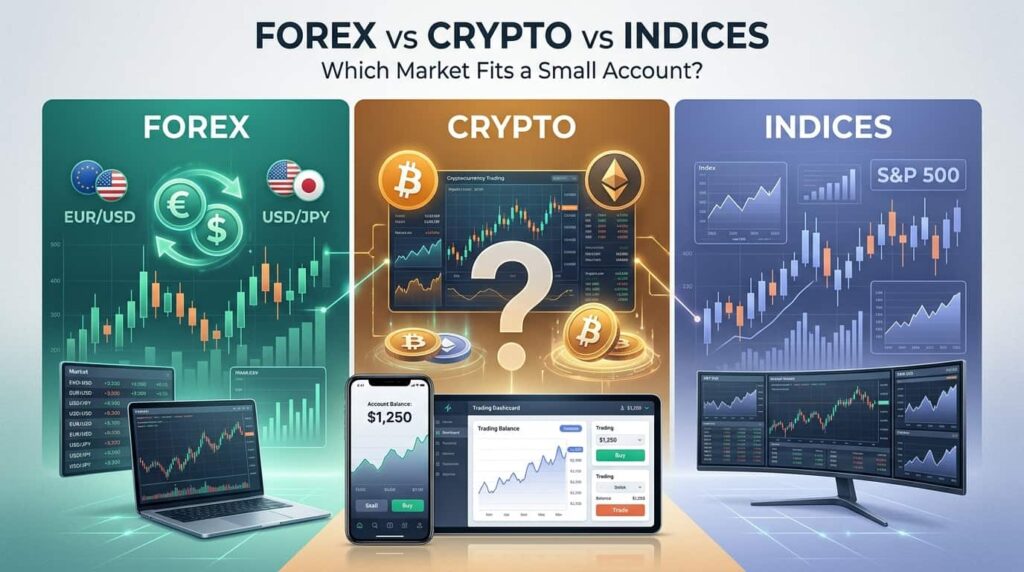
Forex vs. Crypto vs. Indices
Starting trading with a small account can be challenging. Many beginners ask:
Should I trade Forex, Crypto, or Indices?
Each market offers different opportunities, risks, costs, and trading conditions. However, the best market for a small account is not necessarily the one that moves the fastest. It is the market that allows you to manage risk, control emotions, and trade consistently.
In this article, we compare Forex, Crypto, and Indices to help beginners understand their differences.
Important: Trading involves risk. No market guarantees profits, and you can lose your entire trading capital.
Forex vs. Crypto vs. Indices: Quick Comparison
| Feature | Forex | Crypto | Indices |
|---|---|---|---|
| Market | Currencies | Digital assets | Stock market baskets |
| Volatility | Low to medium | High | Medium |
| Trading Hours | Usually 24/5 | 24/7 | Depends on exchange |
| Main Risk | Leverage and currency movements | Extreme price changes | Market and economic news |
| Trading Costs | Spread and commission | Spread, fees, and slippage | Spread and commission |
| Suitable For | Structured trading | High-risk traders | Market trend traders |
| Small Account Challenge | Leverage | Volatility | Contract size and margin |
Market conditions vary depending on the broker, asset, and trading platform.
1. Forex Trading
Forex, or foreign exchange, is the market where currencies are traded. Popular currency pairs include:
- EUR/USD
- GBP/USD
- USD/JPY
- AUD/USD
Forex trading is generally available five days a week and is influenced by interest rates, inflation, economic reports, and central bank decisions.
Advantages of Forex
- High liquidity in major currency pairs
- Often lower spreads on popular pairs
- Many educational resources
- Ability to trade in both directions
- Structured market sessions
Risks of Forex
Leverage is one of the biggest risks. It allows traders to control larger positions with less capital, but losses can also increase quickly.
For example, a trader with a $100 account may open a position that is much larger than their available balance. Even a small price movement against the trade can cause a significant loss.
Risk management is more important than leverage.
2. Cryptocurrency Trading
Cryptocurrency trading involves digital assets such as:
- Bitcoin (BTC)
- Ethereum (ETH)
- Solana (SOL)
Unlike traditional markets, crypto markets generally operate 24 hours a day, seven days a week.
Crypto prices can move sharply because of market sentiment, regulations, technological developments, and major news.
Advantages of Crypto
- 24/7 trading availability
- Many assets and trading opportunities
- Strong price movements
- Possibility of starting with small amounts
- Access to spot and derivatives markets
Risks of Crypto
Crypto can be highly volatile. A coin may rise or fall significantly within a short period.
Other risks include:
- Sudden price crashes
- Exchange security issues
- Low liquidity in smaller coins
- High leverage in futures trading
- Emotional decision-making
Beginners should understand the difference between spot trading and leveraged futures trading. Futures can increase both potential gains and losses.
3. Indices Trading
Indices represent groups of stocks and help track the performance of a particular market.
Popular indices include:
- S&P 500
- Nasdaq 100
- Dow Jones
- FTSE 100
Indices are affected by company earnings, interest rates, economic data, and investor sentiment.
Advantages of Indices
- Exposure to a group of companies
- Useful for studying broader market trends
- Can provide opportunities during major market sessions
- Often followed by professional traders
Risks of Indices
Indices can experience sharp movements during:
- Interest rate announcements
- Inflation reports
- Employment data releases
- Major geopolitical events
- Corporate earnings seasons
Some index products use leverage or CFDs, which can increase the risk of losses. Contract size and margin requirements may also make certain instruments unsuitable for very small accounts.
4. Which Market Has the Highest Volatility?
Volatility describes how quickly and significantly an asset’s price changes.
A simplified illustration:
Crypto:   ██████████  Very High
Indices:  ██████      Medium
Forex:    ████        Low–Medium
This is a general comparison, not a fixed rule. Volatility changes according to the asset, market session, and current news.
Why Volatility Matters
High volatility can create more trading opportunities, but it can also increase losses.
A small account may be affected more quickly because traders often use oversized positions to make faster profits.
More volatility does not automatically mean better trading opportunities.
5. Trading Costs and Fees
Trading costs can reduce your profits, especially when your account is small.
Common costs include:
Forex
- Spread
- Commission
- Overnight or swap charges
Crypto
- Trading fees
- Spread
- Withdrawal fees
- Funding fees in futures
Indices
- Spread
- Commission
- Overnight financing charges
Always check your broker or exchange’s fee structure before trading.
A strategy that appears profitable before costs may become unprofitable after spreads, commissions, and slippage.
6. Leverage: The Biggest Small-Account Risk
Leverage allows traders to control a larger position using less capital.
For example, if a trader uses high leverage, a small price movement may create a large percentage gain or loss relative to their account.
Why Beginners Should Be Careful
Many beginners use excessive leverage because they want to grow their accounts quickly. This can result in:
- Large losses
- Margin calls
- Forced liquidation
- Emotional trading
- Account depletion
Instead of focusing on maximum leverage, traders should focus on position size and maximum acceptable loss.
7. Example: Managing a $100 Trading Account
Consider a hypothetical trader with a $100 account who risks 1% per trade.
| Account Balance | Risk at 1% |
|---|---|
| $100 | $1 |
| $500 | $5 |
| $1,000 | $10 |
These figures are examples of risk planning, not profit predictions.
If a trader loses five consecutive trades while risking 1% of the starting balance, the account will decline. The exact result depends on position sizing and whether risk is adjusted after every trade.
A Better Approach
- Avoid risking the entire account
- Use stop-loss orders where appropriate
- Calculate position size before entering
- Avoid revenge trading
- Keep a trading journal
- Focus on consistency rather than fast growth
8. Which Market Is More Suitable for a Small Account?
There is no single market that suits every trader.
Forex May Suit Traders Who:
- Prefer major currency pairs
- Like structured trading sessions
- Want to study economic news
- Prefer lower volatility in some market conditions
Crypto May Suit Traders Who:
- Understand digital assets
- Can manage high volatility
- Are comfortable with 24/7 market activity
- Avoid excessive futures leverage
Indices May Suit Traders Who:
- Want exposure to broader stock markets
- Prefer studying market trends
- Understand economic announcements
- Can manage contract size and margin requirements
The most important factor is not the market name. It is whether the trader understands the instrument and can control risk.
9. A Simple Small-Account Trading Framework
Before opening a trade, ask yourself:
Step 1: What Is My Maximum Risk?
Decide how much you are willing to lose on one trade.
Step 2: Where Is My Stop-Loss?
Identify the level where your trade idea becomes invalid.
Step 3: Is the Position Too Large?
Calculate your position size based on your account balance and stop-loss distance.
Step 4: What Is the Market Condition?
Check whether the market is trending, ranging, or reacting to important news.
Step 5: Am I Trading Emotionally?
Avoid entering a trade simply because you missed an earlier move.
10. Common Mistakes Made by Small-Account Traders
1. Overtrading
Opening too many trades can increase fees and emotional pressure.
2. Using Excessive Leverage
High leverage can quickly damage a small account.
3. Trading Without a Plan
Entering trades without an entry, exit, and risk strategy can lead to inconsistent results.
4. Chasing Losses
Trying to recover losses immediately often causes even larger losses.
5. Following Unverified Signals
No signal provider can guarantee profitable trades. Always research a strategy before using it.
Forex, Crypto, or Indices: What Should You Learn First?
Beginners should focus on understanding one market before moving between multiple markets.
A practical learning plan could include:
- Learn basic market terminology.
- Understand spreads, commissions, and leverage.
- Practice on a demo account.
- Study risk management.
- Maintain a trading journal.
- Review your results regularly.
- Avoid increasing your position size too quickly.
Demo trading can help you understand market mechanics, although it does not fully reproduce the emotional pressure of real-money trading.
Frequently Asked Questions
Is Forex safer than Crypto?
Forex can have lower volatility in some major currency pairs, but it is not risk-free. Leverage and economic events can cause substantial losses.
Can I start trading with $100?
Some platforms allow small deposits, but account size does not remove trading risk. Fees, minimum position sizes, and leverage requirements should be checked first.
Which market is best for beginners?
The best starting point depends on your knowledge, risk tolerance, available trading hours, and the product offered by your broker. Beginners should prioritize education and risk control.
Is crypto trading available 24/7?
Crypto markets generally operate continuously, including weekends. However, platform maintenance, liquidity differences, and market disruptions can still affect trading.
Can I become rich through trading?
Trading does not guarantee wealth. Consistent results require risk management, knowledge, discipline, and realistic expectations.
Final Thoughts
Forex, Crypto, and Indices all offer different trading experiences.
- Forex offers major currency pairs and structured market sessions.
- Crypto provides 24/7 access but often involves higher volatility.
- Indices offer exposure to broader stock markets but can react strongly to economic news.
For small-account traders, the priority should be protecting capital, managing risk, and developing a consistent trading process.
Instead of asking, “Which market can make me rich quickly?” ask:
Which market can I understand, manage, and trade responsibly?
That mindset can help you build better long-term trading habits.
Disclaimer: This article is for educational purposes only and does not constitute financial advice. Trading involves substantial risk, and losses can exceed expectations when leverage is used.