Leverage is one of the most misunderstood words in trading.
You may have seen phrases like 10:1, 50:1, or 100:1 leverage and wondered what they actually mean.
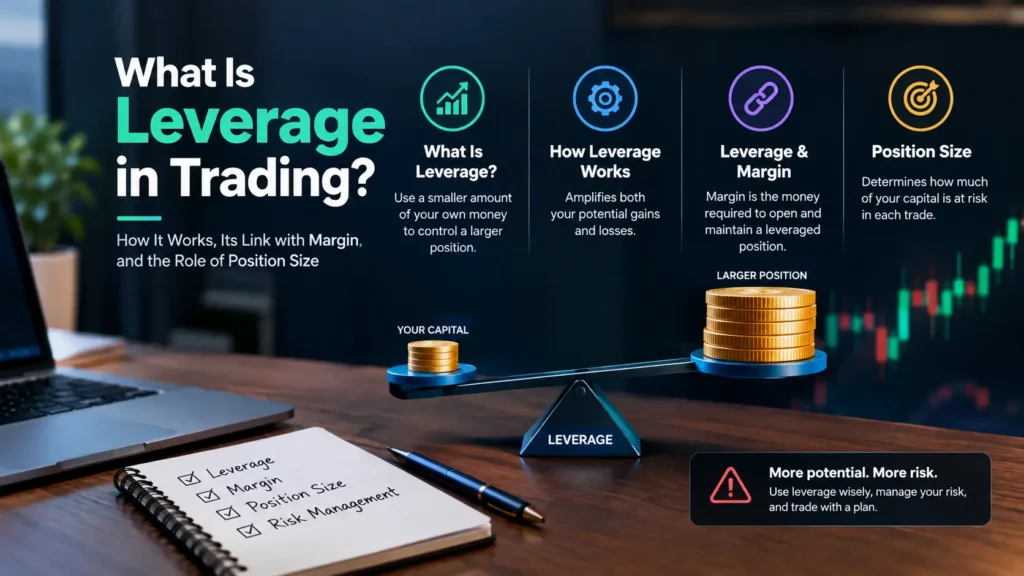
In simple terms, leverage allows a trader to control a larger position with a smaller amount of their own money.
But there is an important catch:
Leverage doesn’t make the market less risky. It makes the financial impact of price movements larger relative to your own capital.
That means it can magnify both gains and losses.
A Simple Example of Leverage
Imagine you want to buy a $1,000 laptop, but you only have $200. A shop allows you to pay $200 upfront and finance the remaining $800.
You now get the benefit of a $1,000 item while putting up only $200 of your own money. That is similar to the basic idea of leverage: using a smaller amount of your own money to control something worth more.
In trading, however, the important difference is that the value of what you’re controlling can move up or down, so your gains and losses can become much larger relative to your own money.
Leverage doesn’t change the market’s movement. It changes how much exposure you have compared with the money you’ve put up.
Leverage vs. Margin: What’s the Difference?
These two terms are connected, but they aren’t the same thing.
Leverage describes the relationship between your exposure and your own capital.
Margin is the money or collateral required to open and maintain a leveraged position.
For example, a 2% margin requirement means $2,000 could be required to control a $100,000 forex position. The CFTC uses this type of example when explaining leveraged retail forex trading.
A useful way to remember it:
Leverage = how much exposure you control.
Margin = the amount required to support that exposure.
Why Do Traders Use Leverage?
The main attraction is capital efficiency.
Without leverage, a trader may need to provide the full value of a position.
With leverage, a smaller amount of capital can support a larger position.
This can be useful in markets where relatively small price movements are common.
But there is a crucial distinction:
Having access to 50:1 leverage doesn’t mean you have to use 50:1 exposure.
A trader can have high available leverage while deliberately taking a much smaller position.
That is why position sizing and risk management matter more than the headline leverage number.
The Hidden Danger: Small Moves Can Become Big Losses
Suppose a trader controls a $20,000 position using $2,000 of their own capital.
If the position falls by 5%, the position loses:
$20,000 × 5% = $1,000
That’s a 50% loss on the trader’s $2,000 capital, before considering fees, interest or other costs.
This is why leverage can become surprisingly dangerous quickly.
With margin trading, losses can sometimes exceed the amount initially invested, depending on the product and account terms. A broker may also require additional funds or liquidate positions when margin requirements aren’t met.
Leverage Is Not Same Everywhere
This is another point beginners often miss.
The way leverage works depends on the market and product.
Stocks
Margin accounts can allow investors to borrow money from a broker to buy securities. The borrowed amount generally carries interest, which reduces returns.
Forex
Retail forex commonly uses margin and leverage, meaning traders can control currency positions larger than the funds deposited for the position. The CFTC warns that losses can consume margin and, depending on the circumstances, may exceed the initial deposit.
Futures
Futures contracts provide substantial market exposure relative to the margin posted. Because futures are standardized contracts with their own margin and settlement rules, traders should not assume the mechanics are identical to a stock margin account.
Crypto
Some crypto platforms offer leveraged products, but the rules, liquidation mechanisms and protections can differ significantly between platforms and jurisdictions.
Never assume that “10x leverage” works exactly the same way everywhere.
The Leverage Trap
Here’s a simple mistake:
A trader has $1,000.
They see that their platform offers 100x leverage.
They think:
“I can control $100,000, so I should use it.”
That’s backwards.
A better question is:
“How much am I willing to lose if this trade goes wrong?”
Then determine your position size from that risk.
This is a much healthier way to think about leverage.
A Better Way to Think About Leverage
Instead of treating leverage as a tool for making bigger profits, think of it as a tool for controlling exposure.
Your process could look like this:
Account size → Maximum acceptable risk → Stop-loss distance → Position size → Required margin → Actual leverage
Notice where leverage appears.
Near the end—not the beginning.
That is an important distinction.
What Happens When a Leveraged Trade Goes Bad?
If losses reduce your account equity enough, you may approach a margin requirement.
Depending on the product and broker, you could be required to add funds or reduce the position.
A broker may also liquidate positions to meet its requirements. Investor.gov warns that margin investors can lose more than their initial investment and that brokerage firms may sell securities without consulting the investor.
So the real danger isn’t simply:
“Leverage is high.”
It is:
“Your position is too large for your risk capacity.”
The 3 Questions to Ask Before Using Leverage
1. How much of my account is actually at risk?
Don’t confuse the margin requirement with your potential loss.
2. What happens if the market moves sharply against me?
Know your stop, liquidation rules, margin requirements and the possibility of slippage.
3. What will leverage cost me?
Depending on the product, costs can include interest, financing charges, spreads, commissions or other fees. Margin loans, for example, generally carry interest.
If you don’t understand these answers, you don’t fully understand the trade.
The Bottom Line
Leverage is neither automatically good nor automatically bad.
It is a mechanism that increases the amount of market exposure you can control relative to your own capital.
Used without discipline, it can make losses happen much faster.
Used with appropriate position sizing and a clear understanding of margin requirements, it can be part of a trading strategy.
But remember the simplest rule:
Don’t ask, “How much leverage can I get?”
Ask, “How much risk am I willing and able to take?”
That small change in thinking can make leverage much easier to understand.
Conclusion
Every trader should keep this thing in their minds that trading is not always about gains and profit but it can sometimes turn against you and brings loss to you so before entering any market make your mind well prepared for both the incoming loss or profit. similarly Leveraged trading can also result in substantial losses, and in some products losses may exceed the amount initially deposited. Rules, margin requirements, liquidation procedures and investor protections vary by product, broker and jurisdiction. Always read the relevant risk disclosures before trading.