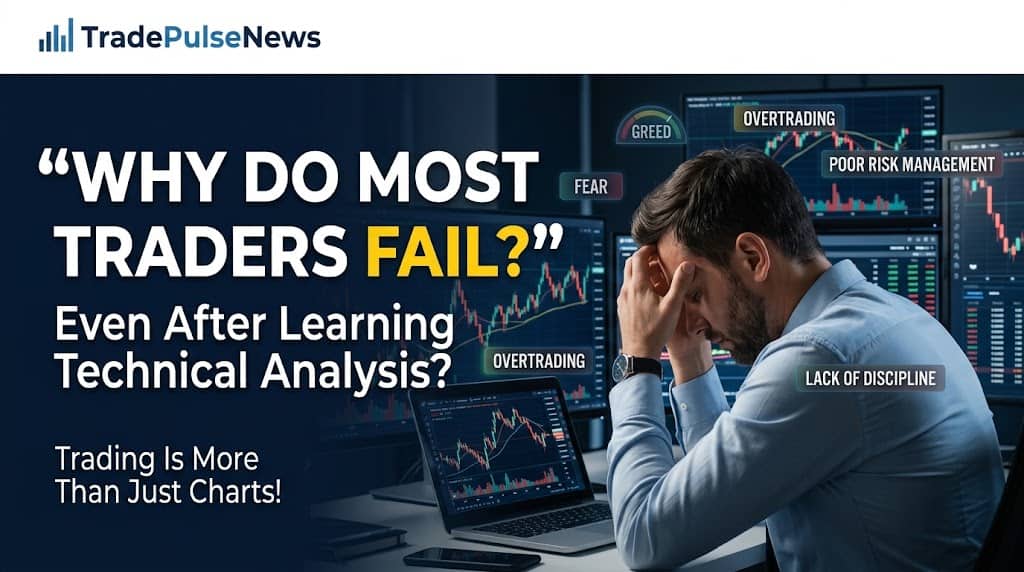
You Know the Charts, But Why Are You Still Losing?
You have learned support and resistance, candlestick patterns, moving averages, RSI, and MACD. You can identify trends and recognize potential trading setups.
But when you enter a real trade, the market moves against you.
You close the trade in frustration—and shortly afterward, the price moves in the direction you expected.
So, what went wrong?
The truth is that technical analysis is only one part of trading. Understanding charts does not automatically teach you how to manage risk, control emotions, or follow a strategy consistently.
Let’s explore why many traders struggle even after learning technical analysis.
1. Technical Analysis Cannot Predict Everything
Technical analysis helps traders identify possible market movements, but no chart pattern guarantees a specific outcome.
A breakout can fail. A support level can break. A trend can reverse because of unexpected news.
Example
A trader notices that Bitcoin breaks above resistance and enters a buy position. A few minutes later, buying pressure disappears, and the price falls below the breakout level.
The trade ends in a loss.
Does this mean the analysis was useless? Not necessarily. The setup may have been reasonable, but the outcome was uncertain.
A good setup can lose, and a poor setup can sometimes win.
The goal is not to predict every price movement. The goal is to build a process that manages uncertainty.
2. Learning More Does Not Always Mean Trading Better
Many beginners watch countless trading videos and learn multiple strategies. However, they often change their approach before properly testing any of them.
Today, they use RSI. Tomorrow, they switch to smart money concepts. The next day, they start scalping.
This creates confusion and inconsistency.
A Better Approach
Focus on one strategy and understand:
- When it works best
- When it fails
- Which market conditions suit it
- Where the trade becomes invalid
- How much risk is appropriate
Learning one strategy deeply is often more useful than collecting dozens of untested methods.
3. Poor Risk Management Can Destroy Good Analysis
Even if your market prediction is correct, excessive risk can damage your account.
Consider two traders who enter the same trade:
- Trader A risks $2.
- Trader B risks $20.
If the trade hits the stop-loss, both traders lose—but the impact on their accounts is very different.
For a $100 account, a $20 loss represents 20% of the capital.
Risk Management Includes:
- Position sizing
- Stop-loss planning
- Leverage control
- Daily loss limits
- Total market exposure
Your risk level should match your account size, strategy, and experience.
Protecting your capital is more important than chasing fast profits.
4. Emotions Can Overrule Your Strategy
A trader may understand technical analysis but still make poor decisions under emotional pressure.
Fear
Closing a trade too early because the price moves slightly against you.
Greed
Increasing position size because you want a larger profit.
Revenge Trading
Opening a new trade immediately after a loss to recover money.
FOMO
Entering a trade late because you fear missing a market movement.
These emotions can affect both beginners and experienced traders.
Before entering a trade, ask yourself:
“Am I following my strategy, or am I reacting emotionally?”
This question can help you recognize impulsive decisions.
5. Overtrading Creates Unnecessary Risk
Not every market movement is a trading opportunity.
When the market is quiet, some traders enter random positions simply because they feel they must trade.
This can lead to:
- Poor-quality setups
- Higher transaction costs
- Emotional exhaustion
- Increased losses
- Excessive exposure
More trades do not automatically mean more profits.
A trader who takes five carefully planned trades may make better decisions than someone who opens twenty positions without a clear strategy.
Sometimes, the best trading decision is to wait.
6. Too Many Indicators Create Confusion
Beginners often add several indicators to their charts, believing that more signals mean better accuracy.
They may use RSI, MACD, Bollinger Bands, multiple moving averages, and several other tools at once.
However, indicators can produce conflicting signals.
A Simpler Trading Plan
Consider focusing on:
- Market trend
- Support and resistance
- One or two confirmation tools
- Clear entry and exit rules
- Defined risk
Indicators should support your analysis—not replace your judgment.
7. A Winning Trade Does Not Always Mean a Good Decision
A trade can make money even when it was poorly planned.
For example, a trader enters without analysis, uses excessive leverage, and happens to profit because the market moves in their favor.
This result may encourage dangerous habits.
On the other hand, a carefully planned trade can lose because of unexpected market movements.
When reviewing your trades, ask:
- Did I follow my strategy?
- Was my risk appropriate?
- Did I have a clear entry reason?
- Did I follow my exit plan?
- Was emotion involved?
Evaluate your process, not just your profits.
8. Unrealistic Expectations Lead to Bigger Losses
Social media often shows traders making large profits in a short time. These posts may not include their previous losses, trading fees, or the risks involved.
When beginners expect quick returns, they may:
- Use excessive leverage
- Overtrade
- Increase position sizes
- Ignore stop-losses
- Risk money they cannot afford to lose
Instead of focusing only on daily profits, focus on:
- Improving your trading process
- Understanding risk
- Reviewing your mistakes
- Developing realistic expectations
Trading does not guarantee regular income or fast wealth.
9. You Are Not Reviewing Your Trades
Without a trading journal, traders often remember their wins but forget their repeated mistakes.
A journal can help you identify patterns in your behavior.
| Journal Detail | Example |
|---|---|
| Asset | EUR/USD |
| Strategy | Breakout |
| Entry Reason | Resistance breakout |
| Risk | Planned amount |
| Result | Loss |
| Emotion | Impatient |
| Followed Plan? | No |
Review your journal regularly to identify:
- Emotional entries
- Excessive trading
- Poor position sizing
- Repeated strategy mistakes
- Trades taken without confirmation
A journal cannot guarantee success, but it can help you understand your trading habits.
How to Improve Your Trading
Follow these practical steps:
1. Focus on One Market
Avoid constantly switching between Forex, Crypto, and Indices.
2. Use One Defined Strategy
Understand its rules and limitations.
3. Test Before Risking Real Money
Use historical data and demo trading to evaluate your approach.
4. Control Your Risk
Use position sizes that allow you to manage potential losses.
5. Keep a Trading Journal
Record your decisions, results, and emotions.
6. Avoid Emotional Trading
Do not trade simply to recover losses or chase market movements.
7. Review Your Results
Evaluate your performance over a meaningful number of trades rather than judging a strategy based on one loss.
Technical Analysis Is Only One Part of Trading
| Skill | Importance |
|---|---|
| Technical Analysis | Identifies possible setups |
| Risk Management | Controls potential exposure |
| Psychology | Helps manage emotions |
| Strategy Testing | Evaluates a trading method |
| Discipline | Supports consistent execution |
| Journaling | Identifies repeated mistakes |
| Patience | Helps avoid unnecessary trades |
No single skill guarantees profitable trading. Stronger decision-making comes from combining these areas.
Frequently Asked Questions
Why do traders lose money even with accurate analysis?
Markets are uncertain. Unexpected news, false breakouts, timing errors, and changing conditions can cause a trade to lose.
Is technical analysis enough?
No. Traders also need risk management, discipline, strategy testing, and emotional control.
How many indicators should beginners use?
There is no fixed number. Beginners should use tools they understand and that support a clear trading plan.
Can a good strategy still lose?
Yes. Even a strategy with a positive historical edge can experience losing trades and losing periods.
How can I identify my biggest trading mistake?
Maintain a trading journal and review your trades regularly. Look for repeated behaviors rather than focusing only on individual results.
Final Thoughts
Learning technical analysis is important, but it is not the complete solution to trading challenges.
Many traders struggle because they focus on predicting prices while ignoring risk management, discipline, patience, and psychology.
Remember:
- No indicator predicts every market movement.
- A winning trade does not always mean a good decision.
- A losing trade does not automatically mean a bad strategy.
- Excessive risk can damage good analysis.
- Patience is an essential trading skill.
Before entering your next trade, ask yourself:
“Do I have a clear setup, a defined risk, and the discipline to accept the outcome?”
If the answer is no, waiting may be better than entering the market.