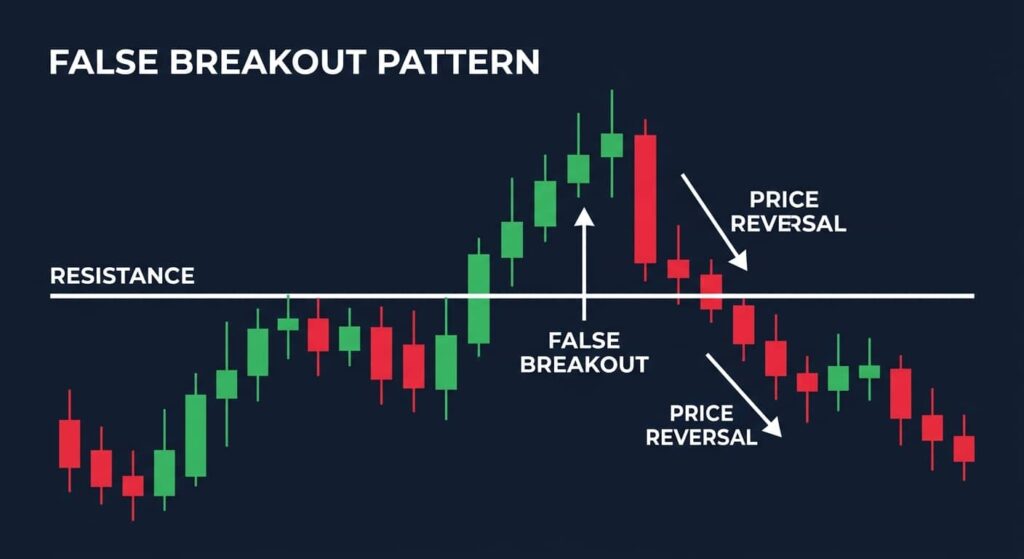
A false breakout in trading happens when the price moves above a resistance level or below a support level but fails to continue in that direction. Instead, the price returns to its previous range, leaving traders who entered on the breakout facing a possible loss. Understanding why false breakouts happen can help traders make more informed decisions and avoid entering trades based on price movement alone.
What Is a False Breakout in Trading?
In technical analysis, traders often watch support and resistance levels to identify potential trading opportunities.
- Support: A price area where buying interest has previously helped slow or stop a decline.
- Resistance: A price area where selling pressure has previously slowed or stopped a rise.
- Breakout: When the price moves beyond a support or resistance area.
- False breakout: When the price moves beyond a level but fails to sustain the move and returns to the previous range.
For example, suppose a stock repeatedly struggles to move above $100. When its price finally rises to $102, traders may interpret the move as a bullish breakout. However, if the price quickly falls back below $100, the breakout may have failed.
This does not mean every move back below resistance is automatically a false breakout. Traders usually assess how the price behaves after crossing the level.
Why Do Price Breakouts Fail?
False breakouts can occur for several reasons. Understanding these factors helps explain why breaking a key price level does not always lead to a strong trend.
1. Buyers or Sellers Cannot Sustain the Move
A breakout needs enough continued buying or selling pressure to maintain the price beyond the broken level. If that pressure fades, the price may return to its previous range.
For instance, buyers may push the price above resistance, but if buying demand weakens and sellers become more active, the upward move may not continue.
2. Traders Enter Too Early
Some traders enter as soon as the price crosses support or resistance. However, a brief move beyond a level does not confirm that the market will continue in the same direction.
Waiting for a candle to close beyond the level or observing a successful retest may provide additional information, although neither approach guarantees a successful trade.
3. Market Conditions Change
A breakout can fail when market conditions change suddenly. Unexpected economic news, changing sentiment, or a lack of follow-through can reverse the initial move.
This is particularly relevant in forex, indices, stocks, and cryptocurrencies, where volatility can change quickly.
4. The Price Returns to Its Previous Range
Some markets spend extended periods moving sideways between support and resistance. During these periods, the price may briefly move outside the range before returning inside it.
Traders who mistake these short-lived moves for the beginning of a new trend may enter positions that quickly move against them.
5. Volume Does Not Support the Breakout
In markets where reliable volume data is available, traders may compare volume during a breakout with recent activity. A breakout accompanied by increased volume can provide supporting evidence, while weak volume may raise questions about participation.
However, volume should not be treated as a standalone confirmation tool. Volume data also varies by market and trading venue, particularly in decentralized forex markets.
How to Identify a Possible False Breakout
No method can identify every false breakout in advance. However, traders can look for several warning signs before deciding whether a trade fits their strategy.
1. Look for a candle close beyond the level.
A brief price spike beyond resistance or support may be less convincing than a candle that closes beyond the level. Even a candle close does not guarantee continuation.
2. Observe the retest.
After breaking resistance, the price may return to test that area. If it holds as support, it may strengthen the breakout case. If the price falls back below the level, the breakout may be weakening.
3. Check the broader market structure.
A breakout that aligns with the prevailing trend may behave differently from one that goes against it. Consider the wider price movement instead of focusing only on a single candle.
4. Consider volume where appropriate.
Compare breakout activity with recent volume, using data suitable for the market being traded.
5. Define your risk before entering.
Decide where the trade idea would be invalidated and how much you are willing to risk. A stop-loss can help manage risk, but execution prices may differ from the requested price during fast markets or gaps.
False Breakout Example
Imagine a currency pair has repeatedly faced resistance around 1.1000.
The price then rises to 1.1020, leading some traders to expect a continued upward move. Soon afterward, the price drops below 1.1000 and returns to its previous trading range.
This is a potential false breakout because the price failed to sustain its move above resistance.
A trader who entered immediately above 1.1000 might face a loss. A trader who waited for additional confirmation might have avoided that entry, but confirmation can also arrive too late or produce a losing trade.
Note: These prices are hypothetical and are used only to explain the concept.
How Can Traders Reduce False Breakout Risks?
Traders cannot eliminate false breakouts, but they can build a more disciplined approach:
- Avoid relying on a single price spike as the only reason to enter.
- Establish clear entry and invalidation rules before placing a trade.
- Consider the broader trend and current market conditions.
- Use position sizing that keeps potential losses within a predefined risk limit.
- Test breakout rules on historical data and assess their performance in different market conditions.
- Record false breakouts in a trading journal to identify recurring mistakes.
Avoid adding too many indicators simply to confirm a trade. A strategy should have clear rules that can be tested rather than relying on multiple signals that may contradict one another.
Final Thoughts
False breakouts are a normal part of financial markets. A price level being crossed does not guarantee that a new trend has started. Breakouts can fail because buying or selling pressure weakens, market conditions change, or the price returns to its previous range.
The key is not to predict every false breakout. It is to recognize uncertainty, follow a tested trading plan, and manage risk when a trade does not work as expected.
A breakout is a possible trading signal, not a promise of continued price movement.
Disclaimer: This article is for educational purposes only and does not constitute financial or investment advice. Trading involves risk, and losses are possible.