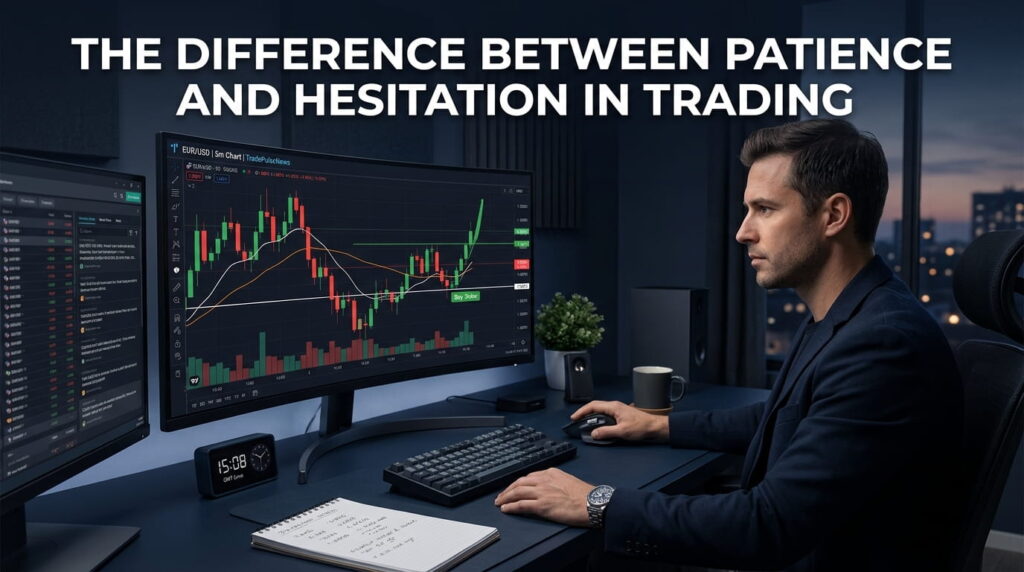
Every trader has experienced this moment: the market approaches a level they have been watching, the setup begins to form, and suddenly they freeze.
They wait for one more candle. Then another. The price moves, the opportunity disappears, and they watch from the sidelines as the market heads in the direction they expected.
But the next time a similar setup appears, they enter too quickly because they do not want to miss out again.
This is one of the most frustrating problems in trading: knowing when to wait and knowing when to act.
Patience and hesitation may look almost identical on a chart, but they come from different places. Patience is waiting because your trading plan tells you to wait. Hesitation is delaying a decision because fear, uncertainty, or the possibility of losing has taken control.
Understanding the difference can help traders make more consistent decisions without turning every market movement into a source of stress.
What Does Patience Mean in Trading?
Patience means allowing the market to meet your predefined conditions before taking a trade.
A patient trader does not enter simply because a candle looks promising or because the price is moving quickly. They wait for a setup that fits their strategy, their risk limits, and their trading plan.
For example, imagine a forex trader is watching EUR/USD near a resistance level. Their strategy requires the price to break above resistance, close beyond it, and then show a suitable retest before entry.
The price approaches the level, but there is no confirmed breakout yet.
A patient trader waits.
If the confirmation appears, they evaluate the entry and risk. If it never appears, they accept that there is no trade.
That is patience—not because the trader is afraid to act, but because they are following a process.
The important point is that patience does not guarantee a winning trade. It helps a trader avoid taking trades that do not meet their own criteria.
What Does Hesitation Mean in Trading?
Hesitation happens when a trader has a valid setup according to their tested plan but struggles to execute it because of emotional uncertainty.
The trader may begin asking:
- What if this trade loses?
- What if the market reverses immediately?
- Should I wait for one more confirmation?
- What if I enter and the price hits my stop-loss again?
These questions are understandable, especially after a series of losses. The problem begins when fear repeatedly overrides the trader’s predefined rules.
Consider a trader whose strategy produces a valid entry signal. The stop-loss is placed at a logical level, the potential loss is within their risk limit, and all required conditions are satisfied.
But the trader remembers their last losing trade and decides not to enter.
The market then moves in the anticipated direction.
It is tempting to conclude that the trader should have entered. However, one missed winner does not prove that the decision was wrong. The better question is whether the trader followed a consistent, tested process.
If they skipped the trade because their rules required another confirmation, that may have been patience. If they skipped it solely because they were afraid of a normal, predefined loss, it may have been hesitation.
Patience vs. Hesitation: The Key Differences
| Patience | Hesitation |
|---|---|
| Follows predefined trading rules | Lets fear change the rules |
| Waits for required confirmation | Keeps demanding extra confirmation |
| Accepts that some opportunities will be missed | Feels distressed about missing opportunities |
| Respects planned risk limits | Often doubts a valid trade even when risk is controlled |
| Can accept both wins and losses | Often needs reassurance before acting |
There is an important distinction: waiting is not automatically patience, and acting quickly is not automatically confidence.
A trader can patiently decide not to trade all day if no valid setup appears. Another trader can enter immediately and still be acting emotionally.
The quality of the decision depends on the plan—not on how fast the decision is made.
Why Traders Become Hesitant
1. Previous losses affect the next decision
After several losing trades, even a perfectly valid setup can feel dangerous. Traders may start treating every new entry as if the previous loss is about to happen again.
But each trade should be evaluated according to the current setup and the strategy’s evidence, not solely according to recent emotions.
A losing streak can be a reason to review performance and risk. It is not, by itself, proof that the next valid trade should be avoided.
2. They expect certainty before entering
No trading setup offers certainty. A breakout can fail, a support level can break, and a strong trend can reverse.
Some traders hesitate because they want the market to prove that a trade will work before they commit.
That proof never arrives.
The realistic goal is not to remove uncertainty. It is to determine whether a trade offers a reasonable opportunity according to a tested method and whether the possible loss is acceptable.
3. They risk more than they can comfortably afford to lose
Sometimes hesitation is not a discipline problem. It is a warning that the position size is too large.
If the thought of losing the planned amount makes a trader panic, they may be taking more risk than they can reasonably handle.
Reducing position size can make it easier to follow a plan. Traders should never increase risk simply to force themselves to become more confident.
4. They keep changing their strategy
A trader who changes entry rules after every loss will struggle to develop confidence in any approach.
One day they require a candle close. The next day they enter before confirmation. After a loss, they add another indicator. After missing a winner, they remove the confirmation entirely.
This constant adjustment makes it difficult to know whether the strategy works.
A better approach is to define entry conditions in advance, test them over a meaningful sample of trades, and change the rules only when evidence supports the change.
How to Know Whether You Should Wait or Take the Trade
Before entering a trade, ask yourself four questions.
1. Has my setup actually formed?
Identify the exact conditions your strategy requires. If one of those conditions is missing, wait. Do not confuse a promising-looking chart with a confirmed setup.
2. Is the risk acceptable?
Know where your trade idea is invalidated, where your stop-loss will be placed, and how much money you could lose. If the risk exceeds your limit, reduce the position size or skip the trade.
3. Am I waiting for a rule—or waiting to feel completely safe?
If you are waiting for a required signal, you may be exercising patience. If every valid signal creates a new reason to delay, fear may be influencing your decisions.
4. Would I make the same decision if I did not know the outcome?
This is a useful way to evaluate your process. A good decision can lose money, and a poor decision can make money. Judge the decision by the information and rules available at the time, not just by what happened afterward.
If your setup is valid and your risk is acceptable, follow your plan. If either condition fails, do not force the trade.
Five Practical Ways to Build Patience Without Becoming Hesitant
1. Write your entry rules before opening the chart
Define the conditions required for a trade, including confirmation, invalidation, and acceptable risk. Clear rules reduce the need to make emotional decisions in the moment.
2. Use alerts instead of watching every candle
Constantly monitoring price movements can create pressure to act. Price alerts at important levels allow you to step away until the market approaches an area that matters to your strategy.
3. Keep your position size manageable
A smaller, appropriately sized position will not make trading risk-free, but it can reduce the emotional pressure associated with each decision. Never risk money you cannot afford to lose.
4. Track missed trades as well as executed trades
Record why you skipped an opportunity. Was confirmation missing? Was the risk too high? Or did fear stop you from following a valid setup?
Over time, this record can help you identify whether you are being selective or repeatedly avoiding trades that meet your rules.
5. Review decisions over a series of trades
Do not judge your discipline based on one missed entry or one winning trade. Review a meaningful sample of decisions to identify patterns and determine whether your rules are being applied consistently.
A Simple Example: Two Traders, the Same Market
Imagine two traders are watching the same EUR/USD setup.
Both have tested strategies that require a candle close above resistance followed by a qualifying retest. Both have predetermined their maximum risk.
Trader A waits because the candle has not closed above resistance. When the required confirmation never appears, they skip the trade.
Trader B sees the same incomplete setup but enters early because they are afraid the market will leave without them.
Later, the price breaks above resistance.
Trader B may make money on that trade, while Trader A misses the move. But that single outcome does not mean Trader B made the better decision. Entering before confirmation may produce a profit sometimes and a loss at other times.
Now imagine the required confirmation does appear. Trader A still refuses to enter because their last trade was a loss, despite the current setup meeting all their rules and the risk remaining acceptable.
That is a different problem. The trader is no longer waiting for a signal; they are allowing a previous outcome to control the current decision.
The lesson is simple: wait when your rules tell you to wait, and act when your rules tell you to act—provided the risk remains acceptable.
Final Thoughts
Patience and hesitation can look the same from the outside. Both can leave a trader sitting on their hands while the market moves.
The difference lies in the reason behind the decision.
Patience comes from a plan. Hesitation often comes from fear overriding that plan. But not every missed trade is a mistake, and not every entry is worth taking.
Successful decision-making is not about catching every move or eliminating the fear of losing. It is about building a repeatable process, controlling risk, and evaluating decisions honestly—even when the outcome is disappointing.
The next time you hesitate in front of a chart, do not simply ask, “Should I enter?”
Ask yourself: “Am I waiting for my setup, or am I waiting for certainty that trading can never provide?”
That question may help you understand what your next decision should be.
Disclaimer: This article is for educational purposes only and is not financial advice. Forex, CFDs, and other leveraged financial products involve substantial risk. No strategy or approach guarantees profits.
About TradePulseNews: TradePulseNews publishes educational content about trading strategies, market behavior, trading psychology, and risk management to help readers make more informed decisions.