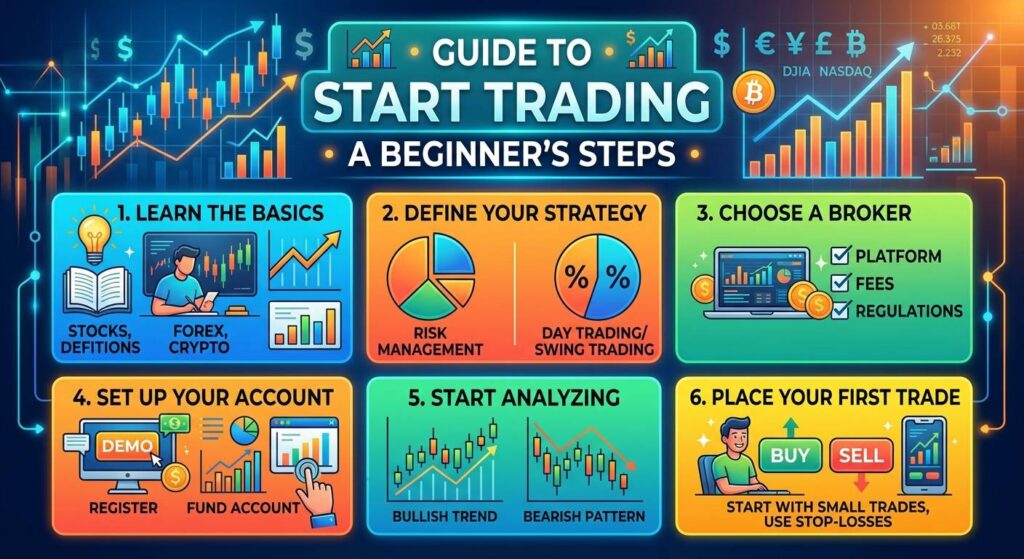
Trading for Beginners
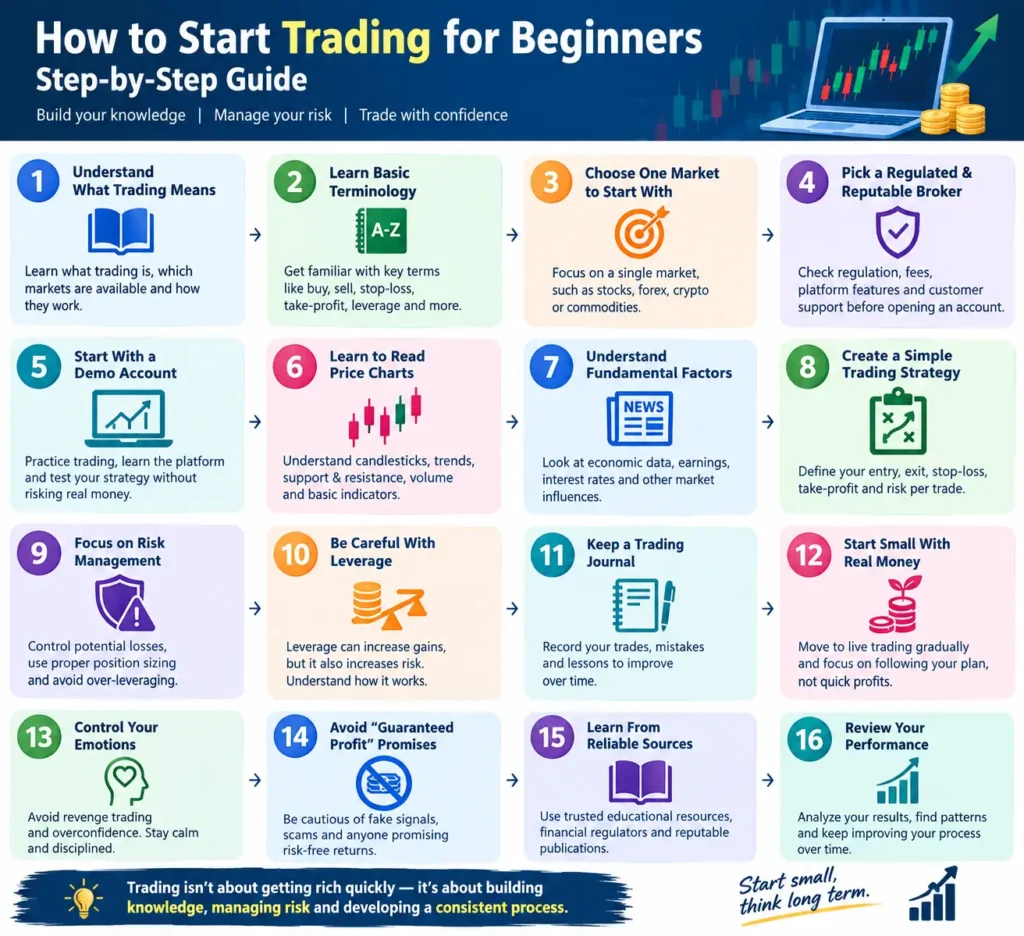
Trading can look complicated when you first encounter charts, candlesticks, indicators, leverage, and financial terminology. But you do not need to understand everything on day one.
The right way to start is to build your knowledge gradually, choose a suitable market, practice before risking significant money, and develop a clear risk-management plan.
This step-by-step guide explains how beginners can approach trading responsibly.
1. Understand What Trading Actually Means
Trading involves buying and selling financial instruments with the goal of benefiting from price movements.
Depending on the market, traders may buy and sell:
- Stocks
- Forex currency pairs
- Commodities such as gold and oil
- Cryptocurrency
- Indices
- Futures and other derivatives
Trading is different from long-term investing. A trader may hold a position for seconds, minutes, hours, days, or sometimes weeks, while an investor may hold an asset for years.
Before putting money into the market, understand what you are trading, how its price moves, what fees apply, and what risks are involved.
2. Learn the Basic Trading Terminologies
You don’t need to become an expert before starting, but you should understand the basic language used by traders.
Some important terms include:
- Buy: Opening a position expecting the price to rise.
- Sell: Closing a long position, or in some markets opening a position expecting the price to fall.
- Bid: The price at which the market is willing to buy.
- Ask: The price at which the market is willing to sell.
- Spread: The difference between the bid and ask price.
- Position size: The amount of an asset you trade.
- Stop-loss: An order or instruction designed to limit potential loss.
- Take-profit: An order intended to close a position at a predetermined profit level.
- Leverage: Using borrowed exposure to control a larger position with a smaller amount of capital.
- Margin: The funds required to open and maintain certain leveraged positions.
Understanding these terms will make trading platforms and educational material much easier to follow.
3. Choose One Market to Learn First
One common beginner mistake is trying to trade everything at once.
Instead, choose one market and learn how it works.
For example, you might begin by studying stocks or a particular group of currency pairs. Spend time understanding their trading hours, liquidity, volatility, fees, and the factors that can influence prices.
Each market behaves differently, so knowledge of one market does not automatically make you an expert in another.
4. Choose a Regulated and Reputable Broker
Your broker provides the platform through which you can access the market.
Do not choose a broker simply because it advertises:
“Guaranteed profits” or “Get rich quickly.”
Before opening an account, investigate:
- Which financial regulator oversees the broker
- What products the broker offers
- Trading and withdrawal fees
- Minimum deposit requirements
- Available customer support
- Security measures
- Whether your country is supported
- Terms and conditions
- Whether the broker clearly explains its risks
Regulation and investor protection vary significantly between countries and financial products. Verify the broker through the relevant regulator rather than relying solely on the broker’s own website.
5. Start With a Demo Account
A demo account allows you to practice trading using simulated funds.
This is useful because you can learn how to:
- Place orders
- Set stop-losses
- Set take-profit levels
- Calculate position sizes
- Read charts
- Monitor open positions
- Understand spreads and fees
- Follow a trading strategy
However, remember that demo trading is not identical to live trading. Real money can create emotional pressure that does not exist when using virtual funds.
6. Learn How to Read Price Charts
Charts help traders study historical price movements.
Start with the basics rather than immediately filling your screen with indicators.
Learn about:
Candlesticks
Candlesticks show information about price movement during a particular period, including the opening, closing, high, and low prices.
Trends
A market can generally move upward, downward, or sideways over a particular period.
Support and resistance
Traders often use these concepts to identify areas where price has previously reacted.
Volume
Volume can provide information about how actively an asset is being traded, although its usefulness varies by market.
You can then gradually explore technical indicators such as moving averages, RSI, or MACD. Indicators should support your analysis rather than replace it.
7. Understand Fundamental Factors
Charts are only part of the picture.
Prices can also be influenced by economic, financial, and geopolitical developments.
For example, stock prices may react to:
- Company earnings
- Revenue and profits
- Interest rates
- Economic conditions
- Industry developments
Currency markets can react to:
- Central-bank decisions
- Inflation data
- Employment reports
- Economic growth
- Political and geopolitical developments
Understanding the factors affecting the market you trade can help you avoid making decisions based purely on a chart pattern.
8. Create a Simple Trading Strategy
Do not enter trades simply because the price “looks like it will go up.”
A trading strategy should clearly explain when you enter, when you exit, and how much you are willing to risk.
For example, a simple strategy might define:
- The market conditions you want to trade.
- Your entry criteria.
- Where your stop-loss will be placed.
- Where you will take profit or otherwise exit.
- How much capital you will risk.
- When you will stay out of the market.
The strategy does not need to be complicated. In fact, a simple strategy that you understand and can consistently test is generally more useful for a beginner than a complicated system full of indicators.
9. Learn Risk Management Before Chasing Profits
This is one of the most important parts of becoming a trader.
A profitable trade does not make a poor risk-management system safe.
Before entering a trade, know:
How much could I lose if I am wrong?
Many beginners focus almost entirely on potential profit. Experienced risk management starts with controlling potential losses.
Avoid putting money into trading that you need for:
- Rent or housing
- Food
- Education
- Emergency expenses
- Debt payments
- Essential household expenses
Only trade with money you can afford to lose.
10. Be Extremely Careful With Leverage
Leverage allows traders to control a position larger than the capital they deposit.
For example, with 10:1 leverage, $1,000 of capital could provide exposure of up to $10,000, depending on the product and broker.
That may increase potential profits, but it also increases potential losses.
A small price movement against a leveraged position can produce a relatively large loss compared with the trader’s own capital. In some products, losses can potentially exceed the initial amount deposited.
For beginners, understanding leverage and margin should come before using them.
11. Keep a Trading Journal
A trading journal records what you did and why you did it.
For every trade, consider recording:
- Date and time
- Asset
- Entry price
- Exit price
- Position size
- Stop-loss
- Take-profit
- Reason for entering
- Reason for exiting
- Result
- What you learned
After several weeks or months, your journal can reveal patterns in your behavior.
You may discover that you trade too frequently, enter without a clear setup, move stop-losses, or trade emotionally after a loss.
12. Start Small When You Move to Live Trading
Once you have practiced sufficiently and understand your strategy, moving from demo trading to real money should be gradual.
Your first goal should not be to make a large profit.
Your first goal should be to execute your plan correctly with real money.
Real trading introduces emotions such as fear, greed, impatience, and the temptation to recover losses quickly.
Starting small gives you an opportunity to experience those emotions without putting a large portion of your capital at risk.
13. Control Your Emotions
Trading decisions can become emotional, particularly after a series of winning or losing trades.
Two common problems are:
Revenge trading
After losing money, a trader immediately enters another trade to try to recover the loss.
Overconfidence
After several successful trades, a trader increases position sizes dramatically because they believe they cannot lose.
Both behaviors can create unnecessary risk.
Having predetermined entry, exit, and risk rules can help reduce emotional decision-making.
14. Avoid “Guaranteed Profit” Promises
Be cautious whenever someone claims that a trading strategy can produce guaranteed or consistent profits with little or no risk.
Real financial markets involve uncertainty.
Be particularly careful with:
- Guaranteed-return schemes
- Unverified trading signals
- Fake investment platforms
- Social-media “gurus”
- Pressure to deposit money quickly
- Requests to send money directly to another person
- Claims that losses are impossible
- Excessive use of screenshots showing supposed profits
Past performance does not guarantee future results.
15. Learn From Reliable Sources
Build your knowledge from credible educational resources rather than relying entirely on social-media influencers.
Useful sources can include:
- Financial regulators
- Stock exchanges
- Central banks
- Reputable brokers’ educational materials
- Established financial publications
- Official economic-data sources
- Books written by experienced market professionals
When someone gives you a trading claim, ask:
What is the evidence?
That simple question can prevent many poor decisions.
16. Review Your Performance Regularly
Do not judge your trading ability based on one trade or one week.
Instead, review your performance over a meaningful sample of trades.
Look at:
- Win rate
- Average winning trade
- Average losing trade
- Total trading costs
- Maximum drawdown
- Whether you followed your strategy
- Whether your risk stayed within your rules
A losing trade does not necessarily mean your strategy was bad. A profitable trade does not necessarily mean your decision was good.
The important question is whether you followed a sound process consistently.
A Simple Beginner Trading Roadmap
If you’re completely new, you can approach trading in this order:
Step 1: Learn how financial markets work
↓
Step 2: Choose one market
↓
Step 3: Learn basic trading terminology
↓
Step 4: Research reputable, regulated brokers
↓
Step 5: Open a demo account
↓
Step 6: Learn basic chart and market analysis
↓
Step 7: Develop and test a simple strategy
↓
Step 8: Learn risk and money management
↓
Step 9: Keep a trading journal
↓
Step 10: Start live trading with a small amount
↓
Step 11: Review your results and improve your process
Final Thoughts
Starting trading is not about finding a secret indicator or discovering a guaranteed strategy. It is about learning how markets work, understanding risk, developing a repeatable process, and gaining experience gradually.
The goal for a beginner should not be to make money as quickly as possible. The goal should be to avoid unnecessary losses while developing the knowledge and discipline needed to make informed trading decisions.
And remember: Trading involves the risk of losing money.