Bitcoin and Ethereum have long dominated the digital asset landscape. Bitcoin established itself as the first decentralized cryptocurrency and is often viewed as a digital store of value, while Ethereum introduced smart contracts that transformed blockchain into a platform for decentralized applications.
However, the digital asset ecosystem has evolved rapidly. Today, innovation extends far beyond these two pioneers, with new technologies reshaping finance, ownership, payments, and investment opportunities.
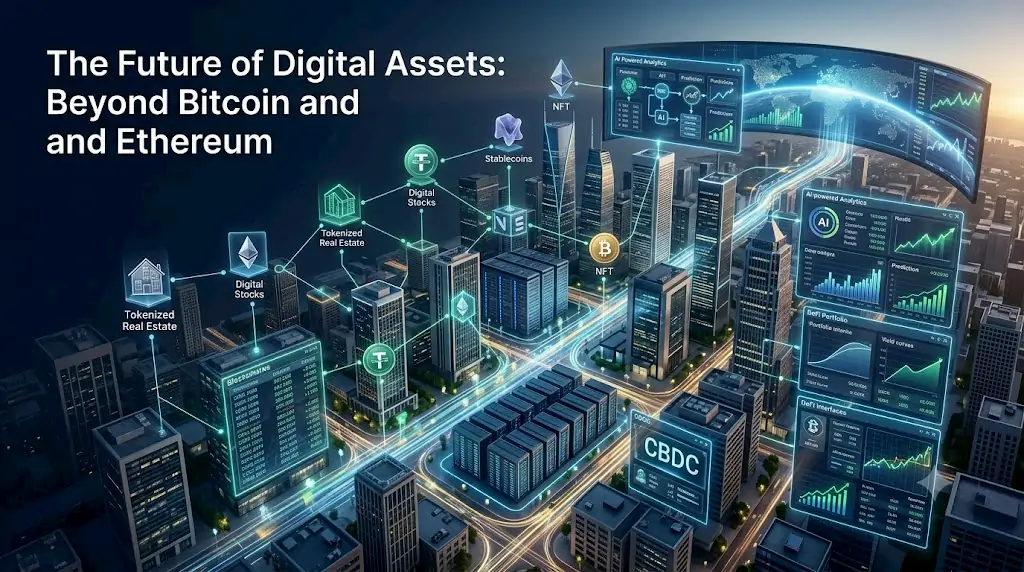
From tokenized real-world assets and decentralized finance (DeFi) to stablecoins, central bank digital currencies (CBDCs), and AI-powered blockchain applications, the future of digital assets is becoming broader and more interconnected.
What Are Digital Assets?
Digital assets are electronically stored items that have value, ownership rights, or utility.
Examples include:
- Cryptocurrencies
- Stablecoins
- Security tokens
- Utility tokens
- Non-fungible tokens (NFTs)
- Tokenized real-world assets
- Digital collectibles
- Central bank digital currencies (CBDCs)
As blockchain technology matures, digital assets are expanding into industries such as finance, gaming, real estate, supply chain management, and intellectual property.
Tokenization of Real-World Assets (RWAs)
One of the fastest-growing areas in digital finance is the tokenization of real-world assets.
Tokenization involves representing ownership of physical or traditional financial assets on a blockchain.
Examples include:
- Real estate
- Government bonds
- Corporate bonds
- Stocks
- Commodities such as gold
- Fine art
- Luxury collectibles
Potential Benefits
- Fractional ownership
- Increased market accessibility
- Faster settlement
- Improved transparency
- Enhanced liquidity
While adoption continues to grow, regulatory frameworks remain an important factor in how these markets develop.
Stablecoins Are Becoming More Important
Stablecoins are digital assets designed to maintain a relatively stable value, often by referencing a fiat currency such as the U.S. dollar.
They play an increasingly important role in:
- Cross-border payments
- Digital commerce
- Trading liquidity
- Decentralized finance (DeFi)
- Remittances
Although stablecoins aim to reduce price volatility, users should understand the underlying reserve models and associated risks.
The Rise of Decentralized Finance (DeFi)
DeFi uses blockchain technology to offer financial services without relying solely on traditional intermediaries.
Common DeFi applications include:
- Lending and borrowing
- Decentralized exchanges (DEXs)
- Yield generation
- Liquidity pools
- Asset management
While DeFi continues to innovate, participants should carefully evaluate smart contract risks, liquidity, and platform security.
Central Bank Digital Currencies (CBDCs)
Many central banks are researching or developing digital versions of their national currencies.
Potential objectives include:
- Faster payments
- Financial inclusion
- Improved payment efficiency
- Reduced transaction costs
- Enhanced settlement systems
The design and implementation of CBDCs vary by country, and their long-term impact on commercial banking and financial markets is still evolving.
Artificial Intelligence Meets Blockchain
Artificial intelligence (AI) and blockchain are increasingly being combined to improve digital asset ecosystems.
Potential applications include:
- Fraud detection
- Smart contract auditing
- Automated trading systems
- Blockchain analytics
- Risk monitoring
- Identity verification
As AI capabilities advance, these technologies may contribute to more efficient and secure digital financial services.
The Evolution of NFTs
Non-fungible tokens (NFTs) have expanded beyond digital artwork.
Emerging use cases include:
- Gaming assets
- Event tickets
- Intellectual property licensing
- Digital identity
- Membership programs
- Music rights
- Real estate documentation
The future value of NFTs will likely depend on practical utility rather than speculation alone.
Blockchain Interoperability
Many blockchain networks currently operate independently.
Interoperability solutions aim to enable:
- Asset transfers between blockchains
- Cross-chain applications
- Shared liquidity
- Better user experiences
Improved interoperability could make blockchain technology more scalable and accessible.
Institutional Adoption Continues to Grow
Institutional interest in digital assets has expanded over recent years.
Examples include:
- Investment funds
- Banks
- Asset managers
- Financial technology companies
- Payment providers
Institutions often focus on custody solutions, compliance, tokenization, and regulated investment products as the market matures.
Challenges Facing Digital Assets
Despite rapid innovation, several challenges remain.
Regulatory Uncertainty
Governments continue to develop policies governing digital assets, and regulations differ significantly across jurisdictions.
Cybersecurity Risks
Digital asset users must remain vigilant against hacking, phishing, and wallet security threats.
Market Volatility
Many cryptocurrencies experience significant price fluctuations, making risk management essential.
Scalability
Some blockchain networks continue to address transaction speed, costs, and network congestion.
Consumer Education
Understanding wallets, private keys, smart contracts, and blockchain security remains a learning curve for many new users.
How Investors Can Prepare
Investors interested in digital assets may benefit from:
- Conducting thorough research before investing.
- Diversifying across asset classes where appropriate.
- Using reputable exchanges and secure wallets.
- Staying informed about regulatory developments.
- Understanding the risks associated with emerging technologies.
- Avoiding decisions based solely on hype or social media trends.
Key Trends to Watch
The future of digital assets is likely to be shaped by:
- Expansion of tokenized real-world assets
- Growth in regulated stablecoins
- Broader institutional participation
- Increased blockchain interoperability
- Integration of AI and blockchain
- Development of CBDCs
- More practical NFT applications
- Stronger regulatory frameworks
- Improved blockchain scalability
Frequently Asked Questions (FAQs)
Are digital assets only cryptocurrencies?
No. Digital assets include cryptocurrencies, stablecoins, NFTs, tokenized securities, digital collectibles, and other blockchain-based assets.
Will Bitcoin and Ethereum remain important?
Many analysts expect Bitcoin and Ethereum to remain influential, but the broader digital asset ecosystem continues to diversify with new technologies and applications.
What are tokenized real-world assets?
They are blockchain-based representations of ownership in physical or traditional financial assets, such as real estate, bonds, or commodities.
Are digital assets suitable for every investor?
Digital assets involve significant risks, including market volatility and regulatory uncertainty. Investors should evaluate whether these investments align with their financial goals and risk tolerance.
Final Thoughts
The future of digital assets extends far beyond Bitcoin and Ethereum. As blockchain technology matures, innovations such as tokenized real-world assets, decentralized finance, stablecoins, AI-powered blockchain solutions, and central bank digital currencies are expanding the possibilities of the digital economy.
While the sector presents exciting opportunities, it also comes with meaningful risks. Investors who prioritize education, security, diversification, and long-term thinking will be better positioned to navigate this rapidly evolving landscape. Rather than focusing solely on individual cryptocurrencies, understanding the broader digital asset ecosystem can provide valuable insight into the future of global finance.
Disclaimer: This article is for educational and informational purposes only and should not be considered financial, legal, or investment advice. Digital assets are subject to market volatility, regulatory changes, and technological risks. Always conduct your own research and consult a qualified financial professional before making investment decisions.