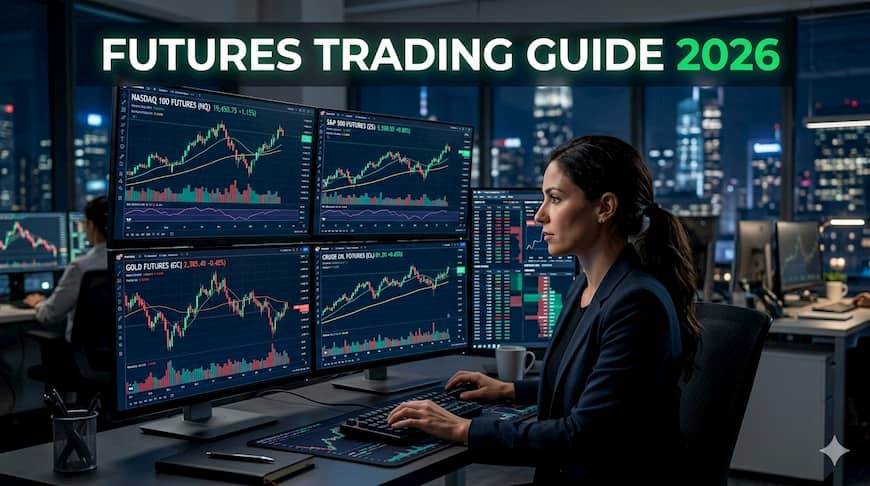
Introduction
Futures trading has become increasingly popular among retail and professional traders due to its liquidity, leverage, and profit potential. Whether you’re trading stock indices, commodities, or currencies, futures markets offer unique opportunities that are not always available in traditional investing.
In this guide, we’ll explain what futures trading is, how it works, its advantages and risks, and how beginners can get started.
What Is Futures Trading?
A futures contract is an agreement between two parties to buy or sell an asset at a predetermined price on a future date.
Unlike stock investing, futures traders typically speculate on price movements rather than taking ownership of the underlying asset.
Popular futures markets include:
- S&P 500 Futures (ES)
- Nasdaq Futures (NQ)
- Crude Oil Futures (CL)
- Gold Futures (GC)
- Silver Futures (SI)
- Treasury Futures
Why Traders Choose Futures Markets
High Liquidity
Major futures contracts are among the most actively traded financial instruments in the world, making it easier to enter and exit positions.
Leverage
Futures allow traders to control larger positions with a relatively small amount of capital. While this increases profit potential, it also increases risk.
Nearly 24-Hour Trading
Many futures markets operate almost around the clock, giving traders flexibility to react to global news and economic events.
Diverse Opportunities
Traders can access multiple asset classes from a single futures trading account.
How Futures Trading Works
Suppose a trader believes the Nasdaq will rise.
They purchase a Nasdaq futures contract. If the index moves higher, the trader profits. If the market declines, the trader incurs a loss.
Unlike traditional investing, traders can also easily profit from falling markets by taking short positions.
Advantages of Futures Trading
Efficient Capital Usage
Leverage allows traders to participate in larger markets without committing substantial capital.
Strong Market Liquidity
High trading volume generally results in tighter spreads and efficient order execution.
Transparent Pricing
Most futures markets are highly regulated and offer transparent pricing structures.
Multiple Trading Strategies
Futures traders can utilize:
- Day trading
- Swing trading
- Scalping
- Trend following
- News trading
Risks of Futures Trading
Leverage Risk
Leverage can amplify losses just as easily as profits.
Market Volatility
Economic data releases, geopolitical events, and central bank announcements can cause sharp market movements.
Emotional Trading
Many traders fail because they lack discipline and proper risk management.
Risk Management Tips
Successful futures traders focus heavily on protecting capital.
Key principles include:
- Use stop-loss orders
- Risk only a small percentage of capital per trade
- Avoid overleveraging
- Follow a written trading plan
- Maintain a trading journal
Best Futures Markets for Beginners
E-mini S&P 500 (ES)
One of the most liquid futures contracts in the world and a favorite among day traders.
Micro E-mini Futures
These contracts offer smaller position sizes and are ideal for newer traders.
Gold Futures (GC)
Popular among traders seeking exposure to precious metals.
Crude Oil Futures (CL)
Offers strong volatility and trading opportunities but requires careful risk management.
Is Futures Trading Right for You?
Futures trading can be an excellent opportunity for disciplined traders who understand risk management and market structure.
However, beginners should spend time learning market mechanics, practicing on simulated accounts, and developing a consistent trading strategy before risking significant capital.
Final Thoughts
Futures trading remains one of the most dynamic and liquid forms of market participation in 2026. From stock indices and commodities to interest rates and currencies, futures markets provide opportunities for traders of all experience levels.
The key to long-term success is not finding the perfect strategy—it’s mastering risk management, maintaining discipline, and continuously improving your trading process.
For traders willing to put in the work, futures trading can become a valuable component of a professional trading career.