Trump-Iran Saga!
Introduction
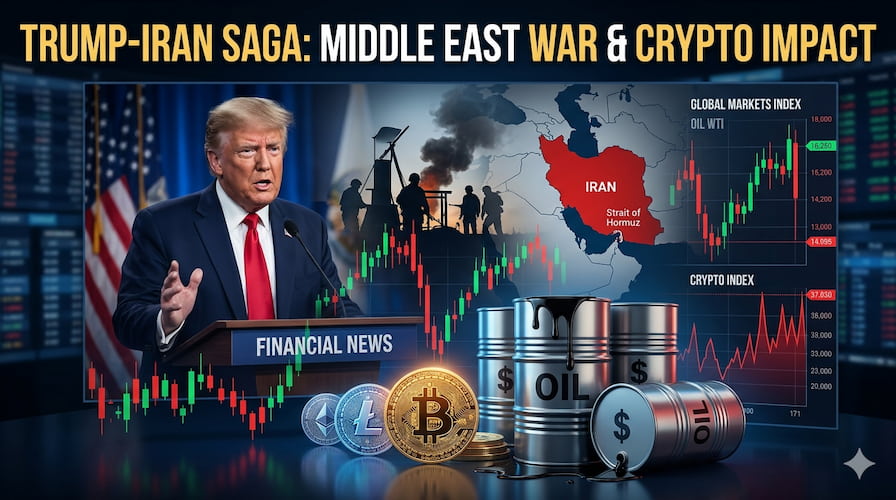
Geopolitical tensions have once again become a major driver of market volatility. The ongoing conflict involving the United States, Iran, and regional actors in the Middle East has created uncertainty across global financial markets, from oil and gold to stocks and cryptocurrencies.
As headlines surrounding President Donald Trump’s policies toward Iran continue to dominate news cycles, traders are closely monitoring how the conflict could affect risk assets, particularly Bitcoin and the broader crypto market.
Why the Middle East Conflict Matters to Traders
The Middle East remains one of the world’s most strategically important regions for energy production. Any disruption to oil supplies or major shipping routes such as the Strait of Hormuz can have significant consequences for global markets. Reuters recently highlighted that the Strait of Hormuz is responsible for roughly 20% of global oil flows, making it a critical economic chokepoint.
Whenever military tensions escalate, investors typically move toward traditional safe-haven assets such as gold and the U.S. dollar while reducing exposure to higher-risk investments.
Immediate Impact on Crypto Markets
Contrary to the narrative that Bitcoin always behaves like “digital gold,” recent market reactions suggest that cryptocurrencies often trade as risk assets during geopolitical crises.
Following renewed military actions and escalating rhetoric involving Iran, Bitcoin experienced sharp volatility while oil and gold prices moved higher. Several market reports noted that crypto traders initially reduced exposure as uncertainty increased.
This reaction highlights an important reality:
- Rising geopolitical risk often triggers short-term crypto selloffs.
- Traders seek liquidity and reduce leverage.
- Altcoins usually experience larger percentage declines than Bitcoin.
- Stablecoins become increasingly important during periods of uncertainty.
Oil Prices: The Hidden Driver of Crypto Sentiment
One of the most important links between the Middle East conflict and cryptocurrency markets is oil.
As tensions between Iran, Israel, and the United States intensified, oil prices repeatedly moved higher due to fears of supply disruptions. Market participants remain highly sensitive to developments involving the Strait of Hormuz and regional energy infrastructure.
Higher energy prices can:
- Increase global inflation pressures.
- Delay interest rate cuts.
- Strengthen the U.S. dollar.
- Reduce investor appetite for speculative assets.
These factors tend to create headwinds for cryptocurrencies.
Bitcoin: Safe Haven or Risk Asset?
The current conflict has reignited a long-running debate among investors.
Supporters argue that Bitcoin serves as a hedge against geopolitical instability and currency debasement. Critics point out that Bitcoin has repeatedly sold off during periods of extreme market stress before eventually recovering.
Recent market behavior suggests that Bitcoin often acts as a risk asset in the short term but may benefit over the longer term if geopolitical uncertainty contributes to inflation, currency weakness, or reduced confidence in traditional financial systems.
What Crypto Traders Should Watch
1. Strait of Hormuz Developments
Any disruption or reopening of shipping routes could significantly affect oil prices and market sentiment. Recent diplomatic efforts have focused heavily on restoring normal operations through the Strait.
2. U.S. Federal Reserve Expectations
If energy prices remain elevated, inflation could stay stubbornly high, affecting future interest rate decisions.
3. Bitcoin ETF Flows
Institutional money flows remain one of the strongest indicators of long-term crypto demand.
4. Stablecoin Activity
Periods of uncertainty often lead to increased stablecoin usage as traders move capital into lower-volatility assets.
Could a Peace Agreement Trigger a Crypto Rally?
Recent reports indicate that negotiations aimed at reducing hostilities are ongoing, although questions remain regarding timing and implementation. Markets have generally reacted positively whenever prospects for de-escalation improve.
A sustained reduction in tensions could:
- Lower oil prices.
- Improve global risk sentiment.
- Encourage capital to return to crypto markets.
- Support Bitcoin and altcoin recovery.
Final Thoughts
The Trump-Iran saga has become more than a geopolitical story—it is now a market-moving event affecting oil, stocks, commodities, and cryptocurrencies.
While Bitcoin remains resilient over the long term, traders should expect continued volatility as headlines emerge from the Middle East. For crypto investors, monitoring developments surrounding Iran, energy markets, and global risk sentiment may be just as important as tracking on-chain data and technical indicators.
In the current environment, risk management remains the most valuable asset in any trader’s portfolio.