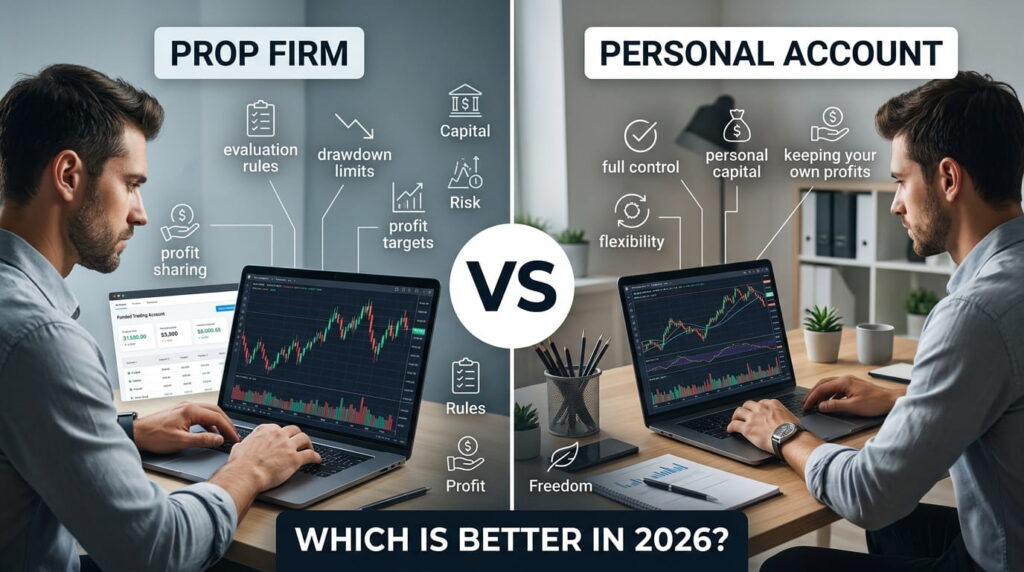
If you’re serious about trading, one question eventually comes up: should you trade your own money or use a prop firm?
At first glance, the choice seems simple.
A personal trading account gives you complete control over your money. A prop firm can give you access to a much larger trading account without requiring you to deposit the full amount yourself.
But there is a catch.
Neither option is automatically better. They come with completely different risks, rules, costs, and psychological pressures.
So, which one makes more sense in 2026?
Let’s look at the real differences without the usual hype.
Prop Firm vs Personal Account: The Basic Difference
With a personal trading account, you deposit your own money with a broker and trade it yourself.
If you deposit $500 and make $100, your account can grow to $600. But if you lose $100, that loss comes directly from your capital.
A prop firm account works differently.
Depending on the firm’s model, you may first have to complete an evaluation or challenge. If you meet its trading requirements, you may receive access to a funded account or a simulated account under the firm’s rules.
Instead of risking a large amount of your own capital, you’re generally paying a fee and agreeing to follow specific trading conditions.
That sounds attractive—but the rules matter.
A trader can be profitable with a strategy and still fail a prop-firm evaluation because of a drawdown limit, daily loss restriction, prohibited trading behavior, or other account rules.
The Real Comparison
| Factor | Prop Firm | Personal Account |
|---|---|---|
| Starting capital | Potentially large account size | Depends on your deposit |
| Personal capital at risk | Usually limited to fees and your own trading expenses | Your deposited trading capital |
| Trading rules | Usually strict | Mostly your own rules |
| Drawdown limits | Usually defined by the firm | You decide your risk tolerance |
| Profit sharing | Usually involved | You keep your trading profits |
| Freedom | Can be restricted | Much greater |
| Scaling | May be available | Depends on your own capital |
| Evaluation | Often required | No evaluation |
| Psychological pressure | Passing rules can create pressure | Losing personal money can create pressure |
The important point is that “bigger account” does not necessarily mean “easier trading.”
1. Prop Firms Can Give Small Traders Access to More Capital
This is probably the biggest attraction.
Imagine a trader has only $1,000 available for trading.
Building a large personal account can take years unless the trader adds significant amounts of capital.
A prop firm may offer an account with a much larger nominal account size, depending on its program.
That can make prop trading attractive to traders who have a tested strategy but don’t have substantial personal capital.
However, don’t make the mistake of thinking:
“$100,000 account = I can lose $100,000.”
You generally can’t.
What matters is the firm’s maximum drawdown and loss limits, not simply the headline account size.
For example, a $100,000 account with a 10% maximum drawdown effectively gives you a much smaller risk cushion than the $100,000 headline figure suggests.
Always read the actual rules.
2. Personal Accounts Give You More Freedom
This is where personal trading has a major advantage.
With your own brokerage account, you generally decide:
- Which strategy to use
- How much to risk
- When to trade
- When to stop
- Whether to hold positions overnight
- Whether to trade during major news
- How frequently to trade
There is no prop firm’s rulebook hanging over every trade.
That freedom can be extremely valuable for experienced traders.
But freedom has another side.
There is nobody else setting your risk limit for you.
If you decide to risk 10% of your account on one trade, that is your decision—and your loss.
3. Prop Firm Rules Can Be Both Helpful and Frustrating
Prop-firm rules aren’t necessarily bad.
In fact, some rules can force traders to develop better discipline.
Daily loss limits, maximum drawdown rules, and position restrictions can prevent reckless trading.
But they can also become a problem if your strategy doesn’t fit the firm’s conditions.
For example, a strategy that normally holds positions through major economic announcements may not work well with a firm that restricts certain news trading.
Similarly, a trader who relies on very high-frequency trading needs to check whether the firm’s rules allow that style.
Before buying any challenge, ask:
Does this firm’s rulebook actually fit the way I trade?
That’s a much better question than simply asking which firm has the biggest account.
4. Personal Trading Has No Profit Split
One major advantage of your own account is simple:
You don’t have to share your trading profits with a prop firm.
If your $2,000 personal account grows to $2,500, the $500 gain belongs to you, subject to your broker’s costs and applicable taxes.
With a prop firm, the trader typically receives a specified share of eligible profits according to the firm’s agreement.
That means you should compare more than the account size.
Look at:
- Profit split
- Fees
- Payout conditions
- Maximum drawdown
- Daily loss limits
- Scaling rules
- Trading restrictions
- Reset or retry costs
- Withdrawal requirements
The headline account size is only one part of the equation.
5. What About Risk?
This is where the decision becomes more personal.
With a personal account:
Your deposited capital is directly exposed to your trading losses.
If you deposit $1,000 and lose $300, your account falls to approximately $700.
With a prop firm:
Your financial exposure may be different, but that does not mean there is no risk.
You may pay an evaluation fee, and you can lose the opportunity to trade the account if you break the firm’s rules.
There are also operational risks to consider, including the firm’s policies, payout terms, platform conditions, and overall business reputation.
So don’t think:
“Prop trading means no risk.”
A more realistic statement is:
Prop trading changes the type and structure of the risk.
6. The Psychological Difference Is Bigger Than Most People Expect
Trading psychology can completely change the experience.
With your own money, seeing a $200 loss can hurt because it is your money.
With a prop firm evaluation, the pressure may come from another direction:
“I can’t hit the drawdown limit.”
That can encourage traders to make poor decisions.
They may:
- Move stop-losses
- Revenge trade
- Increase position size
- Take low-quality setups
- Try to recover losses quickly
- Overtrade after a losing streak
Ironically, a trader can fail a challenge not because their strategy is terrible, but because they become obsessed with passing it.
The solution is the same in both environments:
Risk small enough that one trade doesn’t control your emotions.
7. Which Is Better for Beginners?
There isn’t one universal answer.
A complete beginner shouldn’t assume that buying a prop-firm challenge is a shortcut to becoming a professional trader.
A challenge can actually be expensive education if you don’t already understand:
- Risk management
- Position sizing
- Stop-loss placement
- Trading psychology
- Market structure
- Strategy testing
- Drawdown management
A beginner may be better served by learning and practicing first, using a demo account or a very small amount of capital where appropriate.
Once a trader has a tested strategy and understands risk, a prop firm can become another option to consider.
8. Which Is Better for Experienced Traders?
Experienced traders have more reasons to consider both.
A trader with a proven strategy but limited personal capital may find a prop firm attractive.
A trader with substantial capital may prefer a personal account because of the freedom and lack of profit-sharing requirements.
There is also nothing wrong with using both.
For example, a trader might keep a personal long-term portfolio while using a prop-firm program for a separate trading strategy.
The right choice depends on the trader’s goals—not on which option looks more impressive on social media.
A Simple Example
Suppose two traders each have $1,000 available.
Trader A chooses a personal account
They deposit $1,000 and risk 1% per trade.
That means their initial risk is around $10 per trade.
If they grow the account consistently, the capital remains theirs.
Trader B chooses a prop-firm program
They pay for an evaluation and receive access to a larger nominal account, subject to the firm’s rules.
They may have more trading capacity, but they must respect the firm’s drawdown and other conditions.
Neither trader has discovered a magic shortcut.
Trader A has more freedom but is trading personal capital.
Trader B may have access to more nominal capital but has to operate inside a rulebook.
That’s the real trade-off.
So, Which One Should You Choose?
Here’s a simple way to think about it.
Choose a personal account if:
- You want maximum trading freedom.
- You have enough capital for your strategy.
- You don’t want profit sharing.
- You want complete control over your risk.
- You are comfortable growing your account gradually.
Consider a prop firm if:
- You have limited personal capital.
- You already have a tested strategy.
- You understand risk management.
- You can follow strict rules.
- You are comfortable with profit-sharing arrangements.
- The firm’s rules genuinely fit your trading style.
Don’t choose either simply because:
- Someone on social media posted a huge payout.
- A firm advertises an enormous account size.
- You want to get rich quickly.
- You haven’t tested your strategy.
- You think a funded account removes trading risk.
Those are dangerous reasons to start.
The Bottom Line
Prop firm vs personal trading account isn’t really a question of which one is universally better.
It’s a question of which structure fits your capital, strategy, experience, risk tolerance, and goals.
A prop firm can be useful for a disciplined trader who wants access to more nominal trading capital without putting a large personal deposit at risk.
A personal account can be better for someone who values freedom, wants to keep all of their profits, and has enough capital to trade responsibly.
And for beginners, the smartest move may be neither.
Learn first. Practice. Build a strategy. Understand risk. Then decide where you want to trade.
In trading, the goal isn’t to find the option that looks biggest.
The goal is to find the option that allows you to survive long enough to become consistently profitable.
Final Checklist Before Choosing a Prop Firm
Before paying for any challenge, check:
☐ Maximum daily loss
☐ Maximum overall drawdown
☐ Profit target
☐ Profit split
☐ Evaluation fee
☐ Refund policy
☐ Payout rules
☐ News-trading restrictions
☐ Overnight/weekend restrictions
☐ Trading-platform options
☐ Scaling conditions
☐ Prohibited strategies
☐ Company’s current reputation and terms
Never choose a prop firm based only on its advertised account size. Read the rules first.
Disclaimer
This article is for educational and informational purposes only. Trading forex, CFDs, futures, cryptocurrencies, and other financial instruments involves significant risk and may not be suitable for everyone. Prop-firm programs also have their own terms, restrictions, and risks. Always review the current terms and conditions of a provider and consider your own financial situation before making a decision.