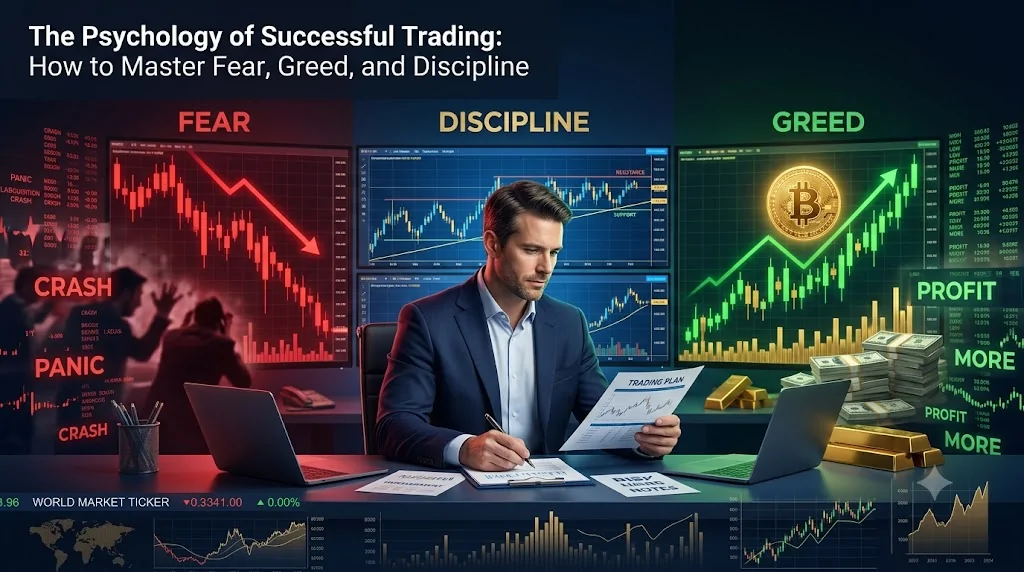
When people think about successful trading, they often focus on technical indicators, chart patterns, or economic news. While these tools are essential, many experienced traders agree that the greatest challenge isn’t the market—it’s managing your own emotions.
Fear can stop you from taking good opportunities. Greed can push you into unnecessary risks. A lack of discipline can turn a profitable strategy into a losing one.
Mastering trading psychology is often what separates consistently successful traders from those who struggle. In this guide, we’ll explore the emotional side of trading and share practical techniques to help you stay focused, disciplined, and confident in any market condition.
Why Trading Psychology Is So Important
Financial markets are driven by human behavior. Every buying and selling decision reflects emotions such as confidence, uncertainty, optimism, or panic.
Even traders with an excellent strategy can lose money if they allow emotions to dictate their decisions.
Professional traders understand that success comes from following a proven process rather than reacting emotionally to every price movement.
Fear: The Biggest Obstacle for Traders
Fear is a natural response to uncertainty, but in trading it can lead to poor decisions.
Common examples include:
- Closing profitable trades too early.
- Hesitating to enter high-quality setups.
- Refusing to trade after experiencing losses.
- Moving stop-loss orders to avoid accepting a loss.
- Constantly checking charts out of anxiety.
Fear often causes traders to miss opportunities or abandon their strategy at the worst possible time.
How to Overcome Fear
- Risk only money you can afford to lose.
- Use predetermined stop-loss and take-profit levels.
- Accept that losses are part of every successful trader’s journey.
- Focus on executing your strategy rather than predicting every market move.
Greed: When More Is Never Enough
Greed often appears after a series of profitable trades.
It can cause traders to:
- Increase position sizes without proper analysis.
- Ignore exit signals.
- Hold winning trades for too long.
- Chase fast-rising assets because of the fear of missing out (FOMO).
- Overtrade in search of bigger profits.
While ambition can be healthy, unchecked greed often leads to unnecessary risk and significant losses.
How to Control Greed
- Set realistic profit targets before entering a trade.
- Follow your trading plan without exception.
- Avoid increasing risk after a winning streak.
- Remember that consistent gains are more valuable than occasional large wins.
Discipline: The Foundation of Long-Term Success
Discipline is the ability to follow your trading rules regardless of emotions.
Disciplined traders:
- Wait patiently for high-probability setups.
- Follow strict risk management rules.
- Never move stop-loss orders impulsively.
- Stick to predetermined position sizes.
- Review their performance regularly.
Discipline transforms trading from gambling into a structured investment process.
Avoid Emotional Trading
Emotional trading usually leads to impulsive decisions.
Warning signs include:
- Entering trades without analysis.
- Constantly changing strategies.
- Revenge trading after losses.
- Trading out of boredom.
- Ignoring risk management.
If you notice these behaviors, it may be time to step away from the screen and reassess your trading plan.
The Importance of Risk Management
No trader wins every trade.
Successful traders focus on protecting capital first and generating profits second.
Effective risk management includes:
- Risking only a small percentage of your account per trade.
- Using stop-loss orders consistently.
- Maintaining a favorable risk-to-reward ratio.
- Diversifying investments when appropriate.
- Avoiding excessive leverage.
Strong risk management reduces emotional pressure and helps traders remain objective.
Keep a Trading Journal
One of the most effective ways to improve trading psychology is by maintaining a trading journal.
Record:
- Entry and exit prices.
- Reasons for each trade.
- Market conditions.
- Emotional state before and after trading.
- Lessons learned.
Reviewing your journal regularly can reveal patterns, identify mistakes, and reinforce good habits.
Build Healthy Trading Habits
Successful traders often share similar routines.
Consider adopting these habits:
- Create a written trading plan.
- Set daily or weekly trading goals.
- Take regular breaks to avoid burnout.
- Continue learning through books, courses, and market analysis.
- Review your performance at the end of each week.
Consistency in your routine often leads to consistency in your results.
Common Psychological Mistakes
Avoid these common emotional traps:
- Fear of Missing Out (FOMO)
- Revenge Trading
- Overconfidence
- Confirmation Bias
- Refusing to Accept Losses
- Overtrading
Recognizing these mistakes early can prevent costly decisions.
Practical Tips to Improve Your Trading Mindset
To strengthen your trading psychology:
- Follow a clear trading plan.
- Be patient and wait for quality opportunities.
- Accept losses as part of the process.
- Focus on long-term consistency instead of quick profits.
- Continue improving your knowledge and skills.
- Stay disciplined even during winning streaks.
Remember, successful trading is a marathon—not a sprint.
Final Thoughts
The financial markets will always present opportunities, but long-term success depends on how well you manage yourself. Fear, greed, and impulsive decisions can undermine even the best trading strategies, while discipline and emotional control can help you navigate both winning and losing periods with confidence.
By developing a structured trading plan, practicing effective risk management, and maintaining a disciplined mindset, you can improve your decision-making and build a stronger foundation for long-term success. Trading psychology is not about eliminating emotions—it’s about ensuring they never control your actions.
Disclaimer: This article is for informational and educational purposes only. It should not be considered financial or investment advice. Always conduct your own research and consult a qualified financial advisor before making investment decisions.